Painted Gold Stripe Tray {by Ari}

DIY decorating projects aren’t just great for saving money. I love the feeling you get when create something that is exactly your vision and absolutely unique. And it’s even more fun when you can share the experience and results with friends. I’m so pleased to introduce you to Ari, my friend, neighbor and fellow working mom/ lover of crafts and decorating. We’ve worked together on quilts for the school fundraiser and shared great times painting furniture and antique hunting. Recently, she got the inspiration to paint decorative trays, and I caught the bug, too.

We picked up some old trays at the flea market last week, and Ari wasted no time getting to work! Here’s the tray she started with, which is one if a pair she picked up for $15 total.

20120514-110324.jpg

This play tray has a cool mid-century feel, but it’s definitely plain. Just wait until Ari works her magic!

Using an inspiration she had found, which is included in my earlier post on ideas for decorating trays, she decided to paint gold stripes on it for her dining room.

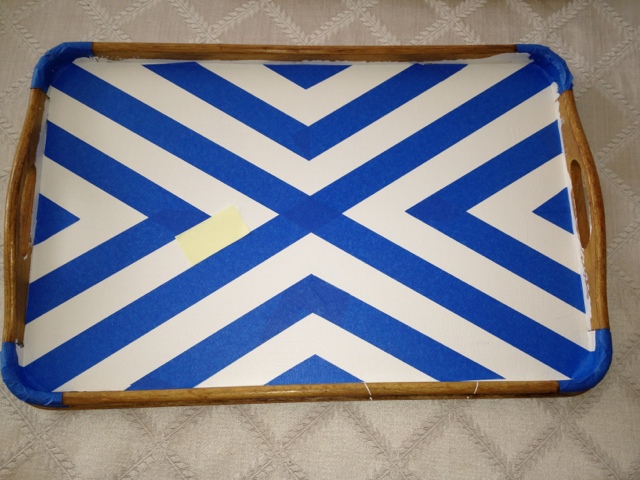
To start, she painted the inside of the tray with a base of white and let that dry overnight. Then she used blue painter’s tape to mask off this great stripe pattern. Chevron and zig-zag patterns are so popular right now, and this is a great play on that idea, without feeling overly trendy. There are metal corners on her tray, so she masked those off, too.

20120514-110735.jpg

Use blue painter’s tape to mark off your pattern. This is a nice play on the popular chevrons and zig-zags.

Now for the fun part, she sprayed the entire tray with metallic gold spray paint. After letting it dry thoroughly, she removed the tape, and WOW! I can hardly recognize that plain old tray. The result is so sophisticated and will look great in the dining room.

20120514-111312.jpg

A glamorous transformation for a flea market find. The gold really shimmers and the stripe pattern is so sophisticated.

We have more big plans for decoupage and stencils on trays. I’m also thinking this technique would look great on a wooden box. Come back soon to see how everything turns out.

“Jewels” and {Ari}

Decorative Pillows to Sew – Idea Book

Inspirations for Pillows

Happy Mother’s Day! (Well, for many years, I didn’t find this day happy at all, because it made me feel my mother’s absence even more, but with three little ones of my own, it is happy again, and I celebrate the many wonderful memories of my own mom, whose creativity and talent are constant inspiration for me. So, if this is a hard day for you, hugs! And I hope it will get better.)

I’m making some throw or accent pillows for our home. Sewing straight lines is a doable project for me, and I like to make pillows using some of the same fabrics that are in other parts of a room (such as the upholstered chairs in our dining room and my craft room), to tie the space together.

With a beautiful fabric, a very simple pillow design will work well. There are also many ways to add interest and details to your pillows, and I’ve been collecting some of those ideas to try:

Embellish with Ribbon:

Ribbon motif pillows

By Caitlin Wilson Textiles. Click the picture for details.

grosgrain ribbon pillow

I like this pattern shown at Better Homes and Gardens. They used fusible web to attach the ribbon. Click the picture for more pillow ideas on their website.

These ribbon details on simple pillows gives a classic and elegant feel. You could also do a simple square.

Use Contrasting Fabric on Back:

reversible throw pillows

I love the look of a different color on the front and back. This picture is from Grosgrain, where Kathleen has some tips on making a quick pillow cover.

Embellish with Buttons:

button pillow

Add a letter or other pattern with buttons. This is a beautiful example by Peggy at Letter Perfect Designs on Etsy. (And I’m not just saying that, because it’s a “J”!) Click the picture to see more beautiful button art!

3-D Felt Embellishments:

butterfly pillow

These three dimensional felt butterflies are so sweet! Click the picture to see the tutorial from Better Homes and Gardens.

Piping/ Welting:

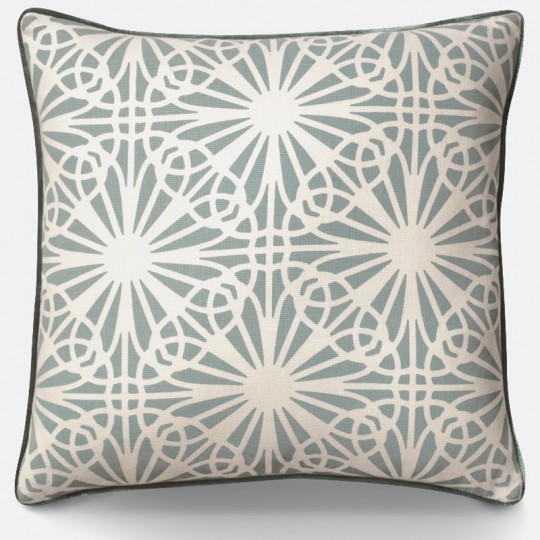
pillow with piping

This pillow is made by Weego Home. Click on the picture to see their stunning collection.

A stunning print like this would be beautiful on its own, but I love the piping detail. Here’s a tutorial on eHow for applying store-bought welting or piping. I’d love to learn how to do that!

Silhouette:

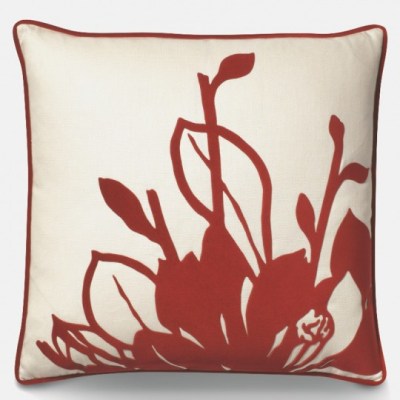
silhouette pillow

This incredible pillow by Weego Home is cut velvet appliqued on linen. I think you could get a similar look with painting on fabric, though obviously, it won’t have the rich feel of this original. Click to see their collection.

Pieced Pillow:

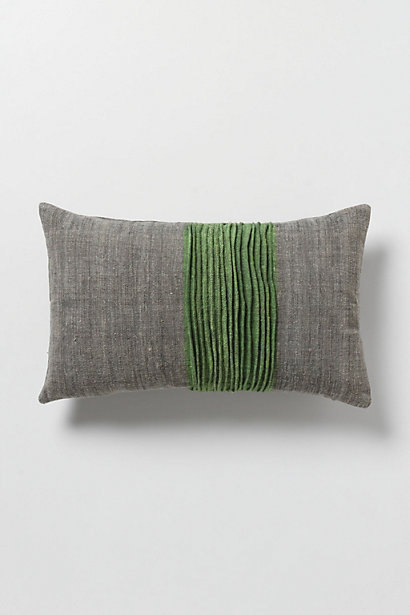
pieced pillow

I like the use of panels made from two fabrics, especially the way it is asymmetrical. This pillow is from Anthropologie, though it is no longer sold.

These are some of my favorite ideas – what are some of yours?

Hope to post my new pillows soon!

P.S. Don’t forget that there’s a May Giveaway. Comment on any post by May 15, and I’ll select a winner to receive a custom wall initial.

“Jewels”

Shoebox Makeovers – Mani-Pedi Kit and Decorative Box

I’m lucky to have a sister for so many reasons – she’s the one person with whom I can be completely myself and share all the funniest and saddest moments. As a fun bonus, little sis loves designer shoes, and I get the beautiful boxes!

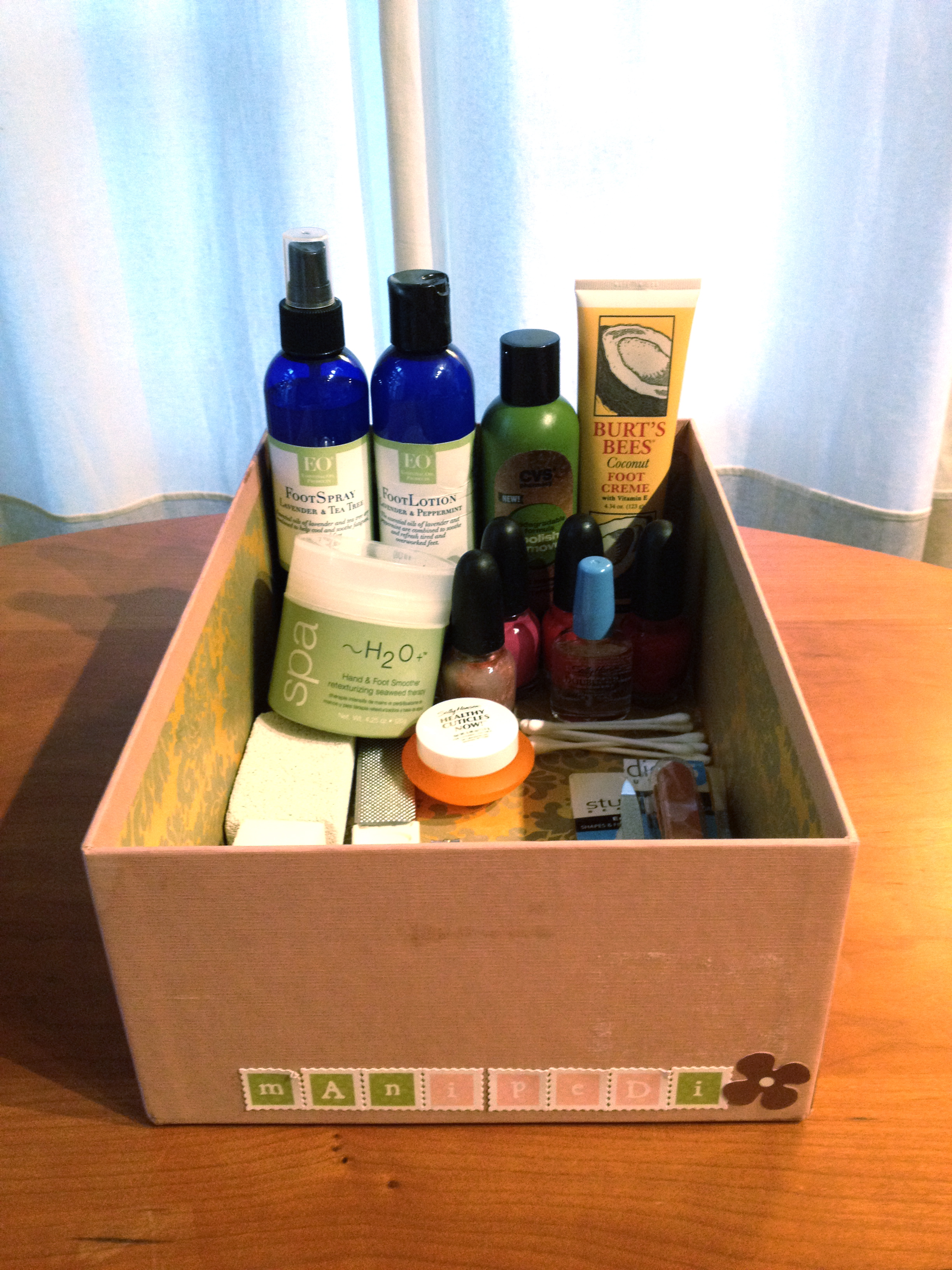
Today is definitely TGIF. Work was busy this week, and I’m ready to shift gears for the weekend. Tomorrow is our school’s annual dinner, and I love the chance to get dressed up and enjoy some time with friends. I don’t get fancied up often, but I decided to paint my nails tonight and was reminded of how easy and fun it was to decorate this shoebox to organize my nail polish and accessories.

Easy mani-pedi kit made from an old shoebox.

Easy mani-pedi kit made from an old shoebox.

Mani-pedi kit inside

There’s enough room for nail polish and accessories. I love the damask lining of this box. You could add your own to a sturdy plain box.

This box was already lined in that pretty metallic damask, but you could glue in a paper or fabric liner to any sturdy box. I used a ribbon and some stickers on the outside to cover up the printing, and now practical little me gets to feel girly and pink once in a while.

shoebox decorated for display.

This beautiful shoebox has a ribbon closure. I added scrapbook paper to the outside.

Another of my sis’ shoeboxes is in our living room. This time, I glued some scrapbook paper over the printing, and it’s ready for display. (Yes, putting photos in frames is on my to-do list!). The style of this box, with the attached lid and ribbon closure gave me the idea to cover some extra test kit boxes from work. Hope to show you that soon.

Okay, now go raid your (sister’s) shoe closet and create your next project!

“Jewels”

Creative Banners and Cupcakes for a Cause

Bake sale! Don’t those words just conjure all good things? The smell of fresh baked treats, hanging out with friends at the sale table, raising money for a good cause… add to that the fact that I was asked to make some crafty signs to advertise our bake sale, and I am in heaven!

For the past four years, a group of my coworkers and our friends have formed a team for the Avon Walk for Breast Cancer. I’ve always been excited by this event, but I was hesitant to join – partly out of the logistical hurdles of training and walking with small kids at home – and partly out of a fear that after working with people with cancer in my job and having lost my mom to breast cancer, participating in this event might lead to emotional overload. I can’t explain why, but for some reason, this seemed like the year that I wanted to make the Avon Walk a part of my journey.

As part of our fundraising and team-building, we are holding a bake sale this year. If you are in San Francisco and can come by the UCSF Cancer Center at 1600 Divisadero Street tomorrow (Friday, May 11, 2012) from 12-3, you can support our team and taste what I guarantee will be a delicious array of treats. We will be outside the cafeteria on the lower level.

The Signs:

These were certainly not works of art, since I threw them together at the last minute, but I still had fun with the design. I had some cake-themed papers from a large pack, so those were the inspiration for the colors. Of course, the pink also tied in to the Avon and breast cancer awareness colors.

I made the cakes stand out from the poster by folding a paper “spring” on the back. And the little pennants give a sweet homemade flavor, just like our desserts!

bake sale banner

I hope our homey bake sale signs with the cheerful pennants attract lots of hungry customers!

The Goodies:

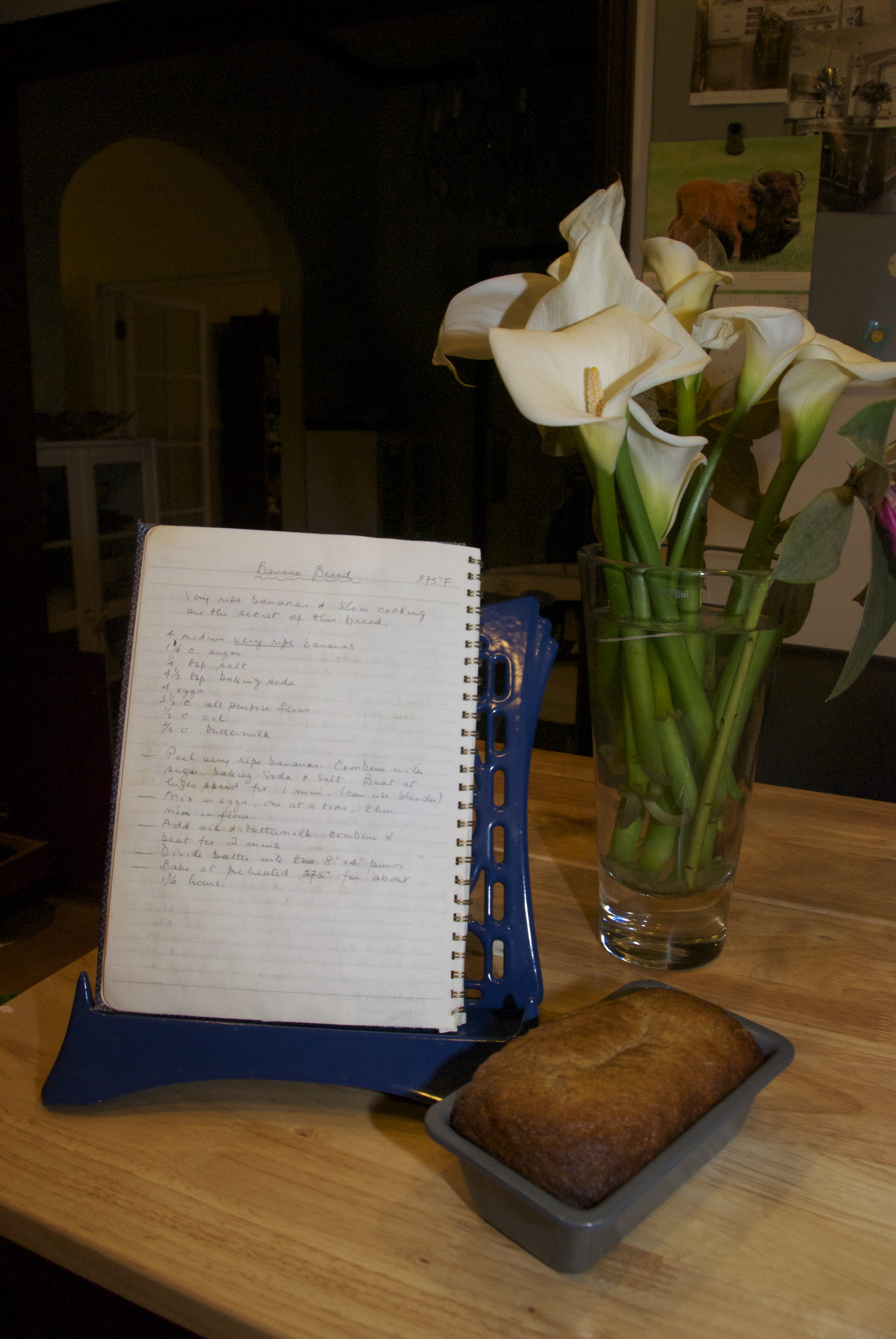
The slight incongruity of selling sweets to raise money for a health-related cause has not escaped me. While I will no doubt be indulging in the brownies and truffles some of my friends have planned, I decided to offer a slightly healthier option, with the banana bread recipe my mom used when I was little. This recipe is in a notebook she gave me when I got married. It has a lot of our “comfort” recipes from childhood and blank pages to record my own. I’m so very glad I have this book. I’m sure it’s just the description she transcribed from the magazine or recipe book, but the sentence “Very ripe bananas and slow cooping are the secret of this banana bread” makes me feel like my mom is sharing a secret just for me.

recipe book

I love seeing my mom’s handwriting in this recipe notebook she gave me when I got married.

Banana Bread:

Very ripe bananas and slow cooking are the secret of this bread.

4 medium very ripe bananas

1 1/4 c sugar

1/4 tsp salt

4 1/2 tsp baking soda

4 eggs

3 1/2 c flour (I mix some whole wheat in)

1/2 c oil (you can use butter for a richer taste)

2/3 c buttermilk (you can substitute yogurt or add a tablespoon of vinegar per cup of regular milk and let the milk sit for five minutes)

Peel very ripe bananas. Combine with sugar, baking soda, and salt. Beat at high spee for 1 minute (can use blender)

Mix in eggs, one a time; then mix in flour

Add oil and buttermlk Combine and beat for 2 minutes

Divide batter into two loaf pans

Bake in preheated 275F oven for about 1 3/4 hours

It’s hard to get a lot of very ripe bananas, at least in this house, because they keep getting eaten. This recipe calls for four, so if we have one or two overripe bananas, we put them in a bag in the freezer to save up until we have enough for banana bread or hubby’s amazing banana waffles.

The new thing I’m trying this time is chopping some of the bananas into chunks and folding them in at the end with the chocolate chips. I had banana bread from Tartine Bakery on Guerrero, which I think is very possibly the best bakery in the city, the other morning that had the small chunks in it, and they were caramelized and delicious!

chunks of banana

Chunks of banana mixed into the batter for a fruity flavor and sweet caramelized morsels.

I love this bread with walnuts and chocolate chips, but we appear to be out of walnuts tonight, so I will have to “make do” with chocolate chips only. Hubby recently articulated that he thinks nuts ruin baked goods, while I think they make them – they’re crunchy, rich, and I love the bit of bitter taste of walnuts against the sweetness of a cookie… obviously he’s wrong, right? He did make me a batch of chocolate chip cookies with nuts for my birthday, and he presented them to me, saying, “I put nuts in these, even though I don’t believe in it.” That’s love.

Sweet dreams!

“Jewels”

DIY Decorative Trays – Ten Great Ideas

Ten Trays

The best decorating projects combine form and function – they add beauty to your space, serve a purpose, and when you make your own, they are one of a kind! A decorative serving tray is just this kind of project. You can use them to display or transport items on a coffee table, buffet, desk, kitchen counter, and more.

My friend Ari got me excited about decorating our own trays when we were at the flea market this past weekend. I picked up an older wooden tray there for just $5, and I know I have a couple of my own lying around the house. I want to use some for display in the living and dining room, and one for the desk in my craft room. There are so many great ideas, and here are some I would love to try or adapt for myself.

Silhouette and Silver

Silver leaf tray

The botanical silhouette and silver leaf on this tray are beautiful.

Brenna at Design Sponge has a tutorial for how she made this tray from a thrift store find! You could simplify it for a similar look with silver spray paint, though the silver leaf looks amazing, and the glass makes the tray useable for serving.

Monogram

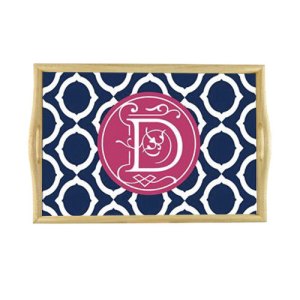
monogram tray

Lots of options to personalize a monogram tray from A Modern Style on Etsy.

This one is by A Modern Style on Etsy. I love the bright colors and graphic design contrasted against the wood.

Wallpaper and Lacquer

Lacquer wallpaper trays

Gorgeous lacquered trays with wallpaper inserts and bold colors from iomoi.

This is from iomoi and hand lacquered, so it would be very durable and stand up to washing and heavy use. The coordinating colors on the body of the tray and the gold trim are gorgeous! I could use some more of the Imperial Trellis wallpaper I have left over from our powder room and lining our bookcases.

Painter’s Tape and Paint

painter's tape tray

Use painter’s tape to mask a design on a plain tray (or paint the tray a background color first). Follow with spray paint – looks great in metallic for a striking graphic design.

Courtney Kaye of Courtney on the Brink made these trays for holding jewelry. They look bold and elegant! I’ve been using metallic spray paint for a lot of projects recently, and I love it!

Tile Mosaic

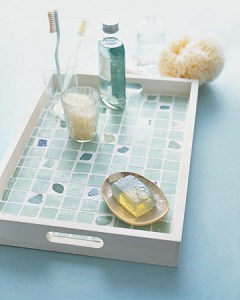
tiled tray

A tile mosaic looks beautiful inside this tray.

This beautiful example, as well as instructions for tiling the inside of a tray, are from the Martha Stewart.

Frame and Fabric

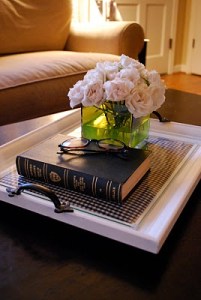
This is an idea to make a tray from a frame and cabinet handles. You can put fabric or pretty paper under the glass.

Patrice from Lemon Tree Creations had this creative idea for making a tray from a frame and cabinet handles. The glass protects the decorative fabric or paper.

Stencil

Stenciled Tray

This stenciled tray is so elegant. I love the painted grey exterior with the white and grey graphic design.

The instructions for stenciling this tray are from HGTV.  Of course, it looks so much like my Imperial Trellis wallpaper, that I could use that for the same look, but there are other great stencil ideas out there, including stenciling words.

Paper Mache

Paper Mache Tray

A sweet little tray made from paper mache and painted different colors inside and out.

Start from scratch! The instructions for making this paper mache tray are at Everything LEB. I love how she used metallic paint inside and the sweet green-blue on the outside.

Decoupage Circles

decoupaged tray

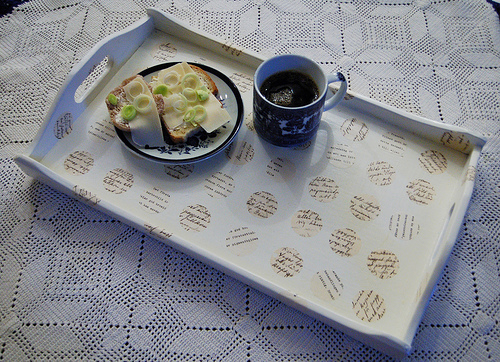
These cute circles have text from old books on them. You could do the same with all sorts of fabrics, papers, and shapes.

A fun and unique example of decoupage from iHanna. There are so many great ways to build on this idea!

Photographs

photo tray

This photo in sepia tones looks beautiful mounted inside a tray.

You could print a single large photograph or several small ones and decoupage them to the inside of a tray and/or mount under glass. This lovely example is from Merle Hillary Interiors.

All these projects would be a perfect way to re-use a tray you already have or give new life to a thrift store or garage sale find. There are also new trays that would work well for makeovers. Here are two very different examples:

Glam Base

west elm trays

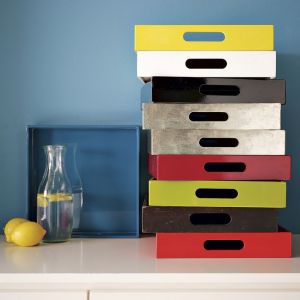
These lacquered trays from West Elm are already gorgeous. You could dress them up in so many ways!

If you want a tray that is already beautiful on its own, these trays from West Elm are a great option. With a simple design and so many colors to choose from, they would also be easy to customize. Only trick I foresee is that it might be a little tricky to get things to adhere well to the lacquer.

Simple Base

For a simple unfinished wood base, try this  Walnut Hollow Unfinished Wood Serving Tray, 15-inch x 11-inch.

Well, that’s my roundup of inspirations for trays to make yourself. I hope Ari and I can find some time soon to work on ours!

“Jewels”

Silver Spray Paints – DIY Apothecary Jar and Painted Screen

Spray paint itself is an amazing product – goes on quickly and evenly for a smooth finish. Metallic spray paint takes the level of wonder a step higher. I have been experimenting with two paints from Krylon’s Special Purpose Metallics line that I found at our neighborhood hardware store, and I think I’m addicted!

Dull Aluminum (1403) is what I used on the little box from the rummage sale. Despite its name, I don’t find it dull. It gives a cool grey/silver finish that looks like it’s painted – okay, I know that sounds obvious, but I mention it in contrast to the Bright Silver (1401), which looks more like a real metal finish.

metallic spray paints

Projects using Krylon “Dull Aluminum” and “Bright Silver” paints.

Here are some projects I’ve tried with each, and I’m already thinking about what to do next. Let me know if you have suggestions!

Bright Silver Paint
I’ve been trying to find more projects that reuse old things. Recycling is great, but it still uses a lot of energy and produces waste. Reusing is good for our planet and our pocketbooks, too! The challenge is to find projects that reuse old items but don’t look like a preschool art project!

This idea for a DIY apothecary jar is not original to me. I’ve seen it in several places, including Parties for Pennies.

DIY apothecary jar

DIY apothecary jar made from a used jar, a cabinet knob, and metallic spray paint.

You will need:

  • glass jar with lid
  • cabinet knob with bolt
  • washer
  • drill
  • sandpaper
  • spray primer
  • metallic spray paint
  • clear finish spray

1. Sand the lid to roughen it up for the paint to stick.

2. Drill a hole in the center of the lid

3. Insert the the bolt and washer from under the lid and screw on the knob

4. Spray primer, then paint (2 coats), and seal with a clear finish. Let each coat dry before continuing.

20120507-182007.jpg

Another view of a DIY apothecary jar made from a used jar, a cabinet knob, and spray paint.

It’s such a creative and satisfying project. We use jars all the time, and I have a ton of knobs leftover from replacing the dated brass and black ones in our kitchen, so I’m thinking of making lots of these as gifts!

Dull Aluminum Paint

I used this paint on a couple of projects recently. This is actually a pretty silver-colored paint; I don’t like the word “dull” in it’s name! The first was for painting this box I picked up for five dollars at a rummage sale:

side table styling

This dull old box was painted silver with Krylon Dull Aluminum paint and looks beautiful in our living room!

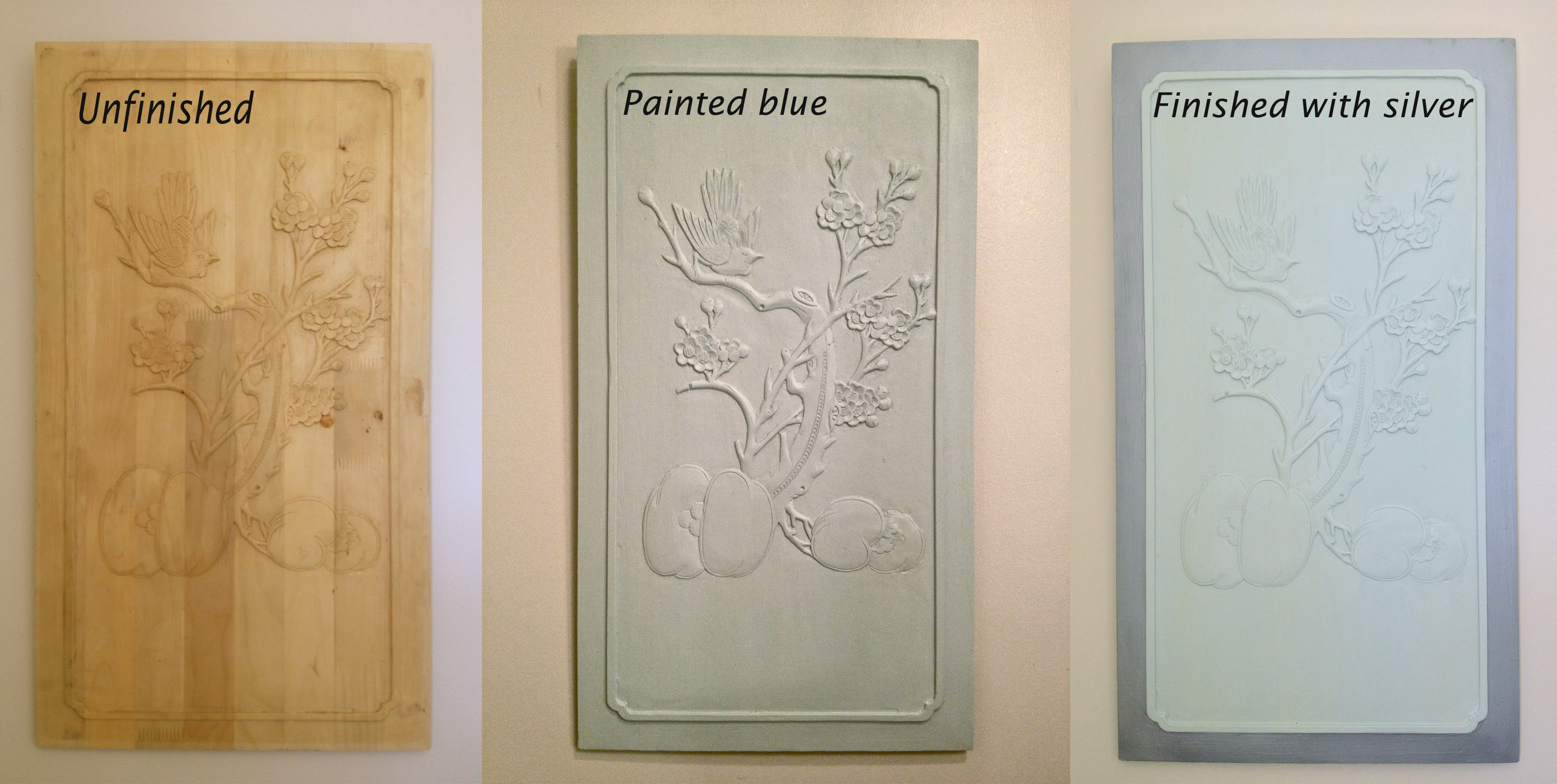
I also used this more muted (I refuse to call it dull!) metallic paint to finish off a screen I was painting to hang in our master bathroom. This was an example of “the third time’s a charm.” I started with the bare wood screen, and hoped to use it that way, but it was just too rough and unfinished. Next, I painted it a pale blue (Swept Away by Benjamin Moore), which I had leftover from painting our kids’ bath and also used to paint another screen. The blue paint was an improvement, but it still felt unfinished, so I masked off the center and sprayed the border in silver. Sometimes, it takes a few tries to get the look you want, but it was worth it!

painted screen

It took a few tries to get the look I wanted for this screen. The silver spray paint really makes it feel elegant and finished!

painted blue and silver screen

A closer view of the finished screen in blue and silver.

These metallic paints are really so easy to use for a spectacular effect. Some other great uses I’ve seen and would love to try are:

  • spray branches for a vase arrangement
  • spray a decorative tray
  • spray ceramic vases or bowls for display
  • make pendants out of clay – thumbprints, engraved words, etc. and spray with silver, so they look like stamped metal
  • more DIY apothecary jars for sure!

“Jewels”

This project is shared at:

Sew a Growth Chart – Tutorial

Bad news: I’m blogging and sewing tonight while sitting on a step stool. Good news: it’s because I am in the middle of making over my free Craigslist Queen Anne chairs for the sewing room. They are already repainted, and I just need to re-do the seats, which I hope to do this weekend.  Wait! What was I supposed to be talking about… oh yes…

In a recent post, I brainstormed ways to help my friend preserve the record of her children’s heights marked on a door jamb in their house. I loved looking at all the great ideas out there, as well as coming up with some of my own.

At the end of that post, I included a picture of the hanging fabric growth charts I made for my kids. In case you want to make one for your family or as a gift (I first designed this as a baby shower gift!), I’ve broken down the steps here. Let me know if you have any questions!

As I mentioned last time, I’m sure there are similar growth charts out there, but I designed this one myself, keeping in mind that I wanted it to be

  • portable – so that we could take it with us when we moved (a feature this post proves is valuable!)
  • easy to store – fabric can be rolled up for compact storage and ironed later – wood, obviously, cannot, and paper could get folds and wrinkles – though you could wrap around a paper towel roll to minimize this.
  • complete – I wanted to be able to record my kids’ growth from birth to adulthood. Many ready-made growth charts stop around five feet. Granted, most tweens and teens may not have any interest in growth charts anymore, but their parents might, so I made mine go up about 6’2″, just in case!

The finished size of this growth chart is approximately 11.5″ wide x 54.5″ high.

For each chart, you will need:

  • fabric markers or sharpies
  • white fabric (8.5″x58″): I used white cotton twill, which I chose for its stability and weight
  • backing fabric: I used twill or denim, again to add stability and weight
  • border fabric (equivalent to 1/2 yard of 42″ wide calico): I won’t be bossy here – use whatever you like!
  • 1/2″ diameter wooden dowel (approximately 2′ long)
  • two small screw eyes
  • ribbon for hanging

1) On a strip of white fabric that is 8.5″ wide for each growth chart, mark out inches from 1’6″ to 6’2″ (or whatever you like) by laying a tape measure on the fabric and using a ruler to draw lines with a fabric marker or Sharpie. I used a different color and longer marking every six inches. The short lines are 1.5″ and the long lines are 2″. Remember that lines on the finished product will be shorter, because a 1/2″ will be in the seam allowance.

If you are making more than one growth chart, you can be efficient and mark lines for two at a time, as shown below. You will need a slightly longer fabric strip and want to number from both ends, so the marks are on the left of each chart.

growth chart

Inches marked on white fabric using fabric markers.

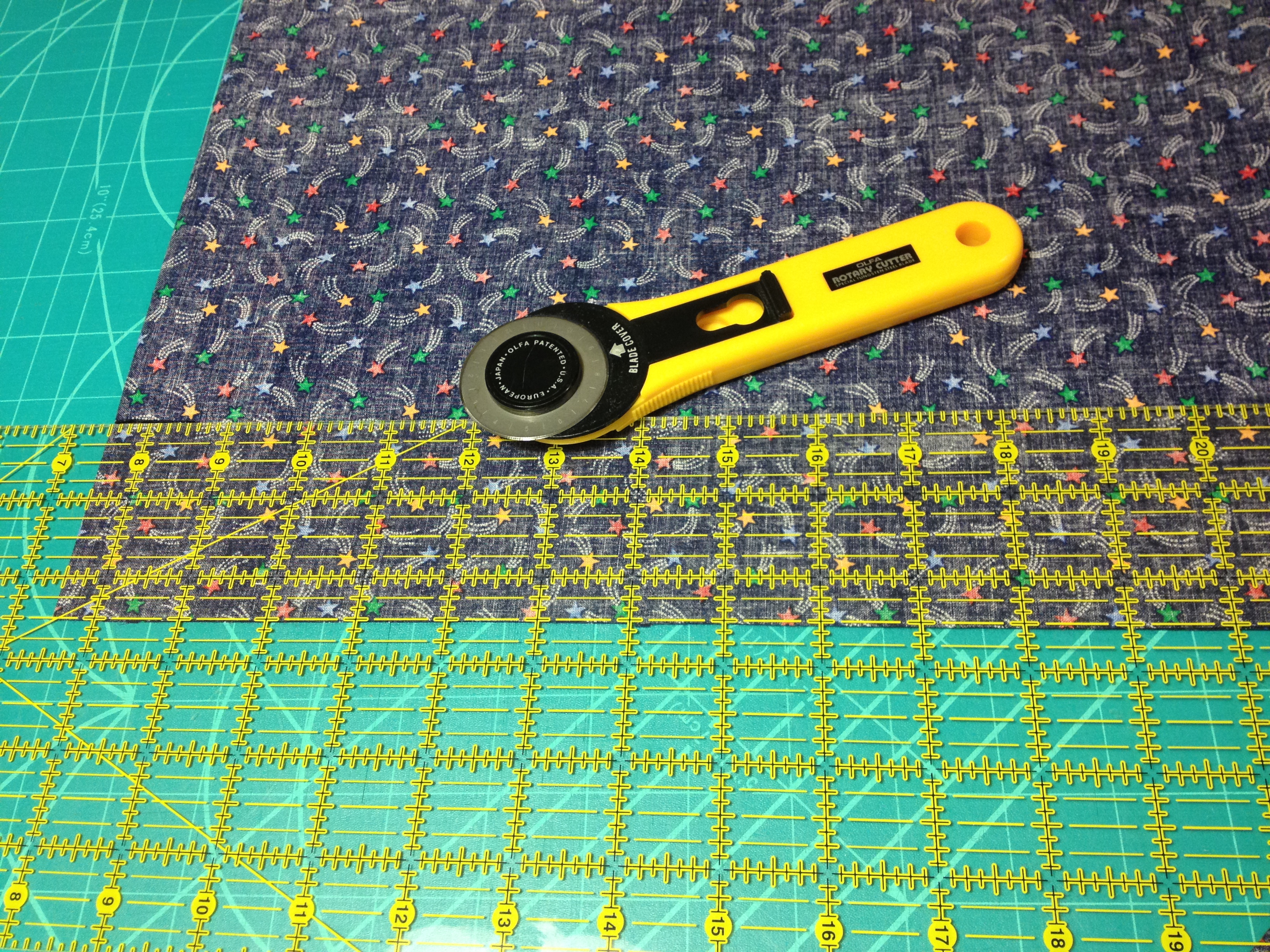
2) Cut out strips for a border. The side strips are 2.5″ wide. The chart should be 58″ long, but cut your strips about an inch longer, in case you are like me, and straight lines magically transform into uneven ones… For preparing the border, I used a rotary cutter with quilting ruler and mat. These tools are designed for quilting, where you have to piece together very precise lines and angles, but they work well for lots of other projects.

Quilting tools

Quilting tools: rotary cutter, quilting ruler, and mat. These are so useful for getting straight lines and square angles on all sorts of projects. I even use the mat and ruler for cutting paper.

3) Sew the side strips onto the white center, using a half inch seam allowance. Iron flat, with the seam toward the border. Trim the border pieces so they are flush with the white section. Again, the quilting tools are great for getting things straight and square.

4) Next, cut strips for the top and bottom border. These are 5.75″tall, and they should be 11.5″ wide. Again, I cut the pieces a bit wider, to compensate for the nasty elves in the sewing machine. Sew these on to the top and bottom, using a half inch seam allowance. Iron with the seam toward the border. Now that the front is complete, trim where necessary to make sure it’s even (square at the corners, same height on both sides, same width at top and bottom).

joiining growth chart

After trimming the center piece, join the top and bottom borders.

You could add any decorations you want to the front at this point. I put each child’s name at the top, piecing together letters from a fun teddy bear alphabet print. I also added a “Made with love by ‘Jewels'” tag to the bottom.

name label

I put each child’s name on his growth chart using letters from this cute teddy bear print.

5) Cut a piece of backing that is the full size of the front (should be about 11.5″ wide and 69″ long, but measure your actual piece).

6) With RIGHT sides together, pin, then sew the front and back pieces together, using a half inch seam allowance, leaving one of the short ends open, so you can turn the piece.

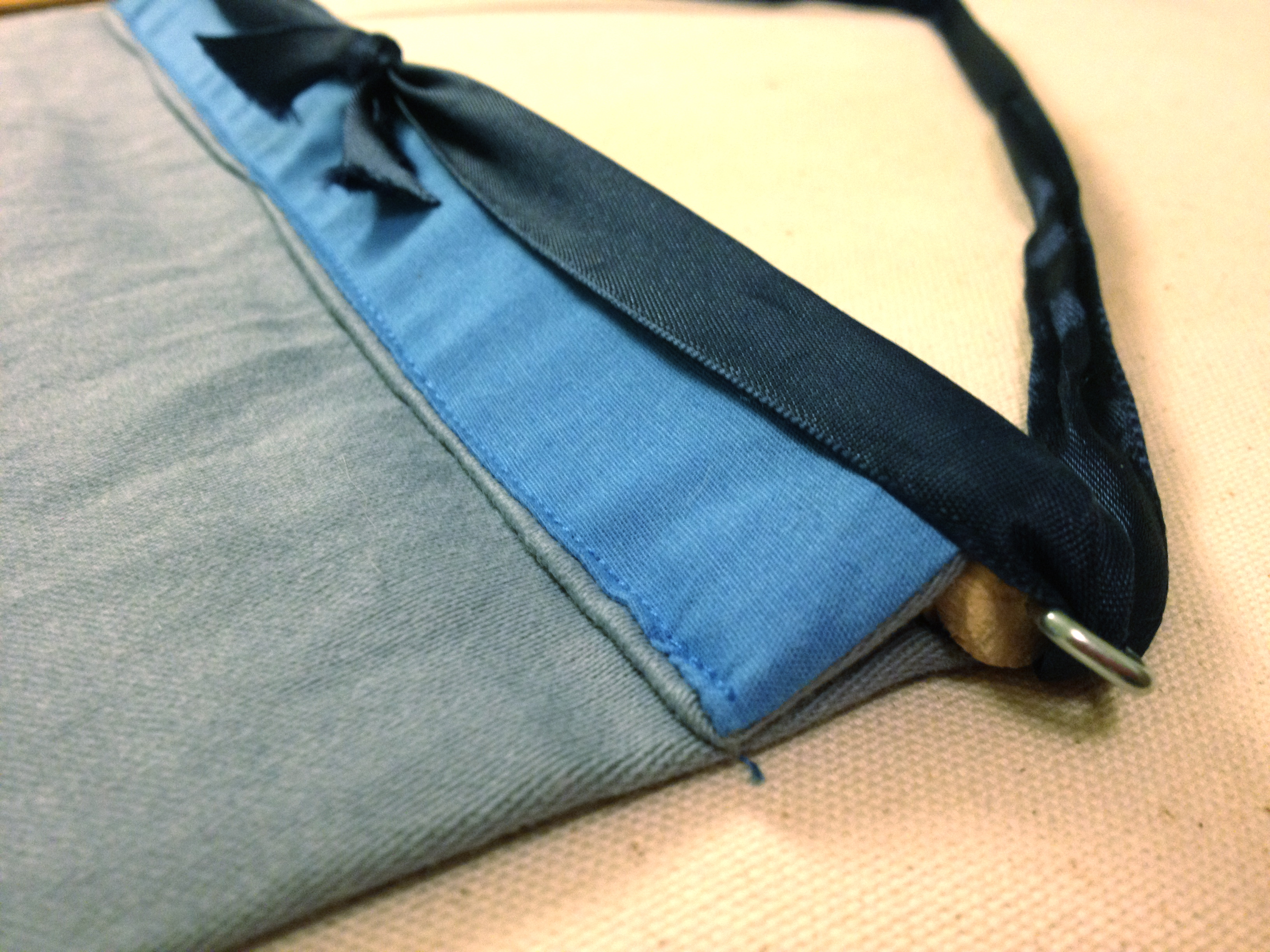
7) Cut diagonal triangles from the corners, so they turn neatly. Then, turn the growth chart right side out and tuck a half inch seam allowance under on the open end. Iron the whole piece flat.

trim corners

Cutting across the diagonal at the corner will give a neater finished appearance.

8) Cut two pieces of doweling that are the same length or a tiny bit shorter than the finished width of your growth chart. Attach the screw eyes to both ends of one piece.

9) Fold towards the back and sew down a 1.25″ flap on the top and bottom to create a pocket for the dowels.  This will also close the end you left open.

10) Insert the plain dowel in the bottom pocket and the one with the screw eyes in the top.  Thread a ribbon through the screw eyes to hang the chart.

finishing the chart

Finish: Sew 1.25″ flaps on the top and bottom to hold the dowels. Insert screw eyes in the top piece and thread a ribbon through for hanging.

Tada!  The finished growth charts are hanging in the hallway outside our kids’ bath, opposite the newly organized laundry area.

finished growth charts

Finished growth charts

Hope I made that clear. I’d love to see pictures, if you make one of these yourself!

“Jewels”
This project is shared at:
May 2012 Givewaway – A Custom Wall Initial

The giveaway is now closed.  Thanks for all the comments.  The lucky winner is Jenny.  Since her two girls share a room, she convinced me to make a letter for each of them.  I’ll post those soon.

Original post:

Welcome to the first Jewels at Home Giveaway! Remember these custom oversize initials I made for the kids’ rooms?

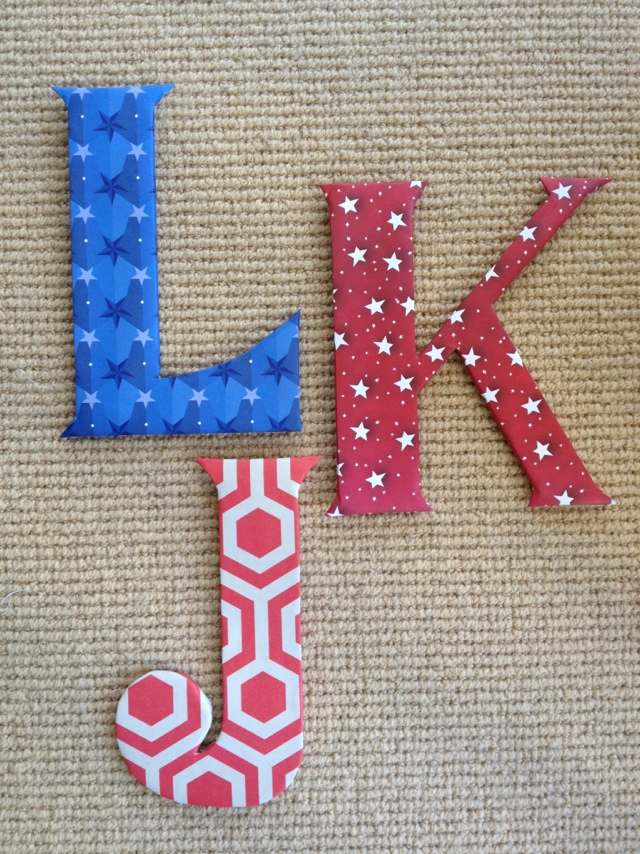
DIY paper-wrapped wall initials by Jewels at Home

DIY paper-wrapped wall initials for my boys’ rooms!

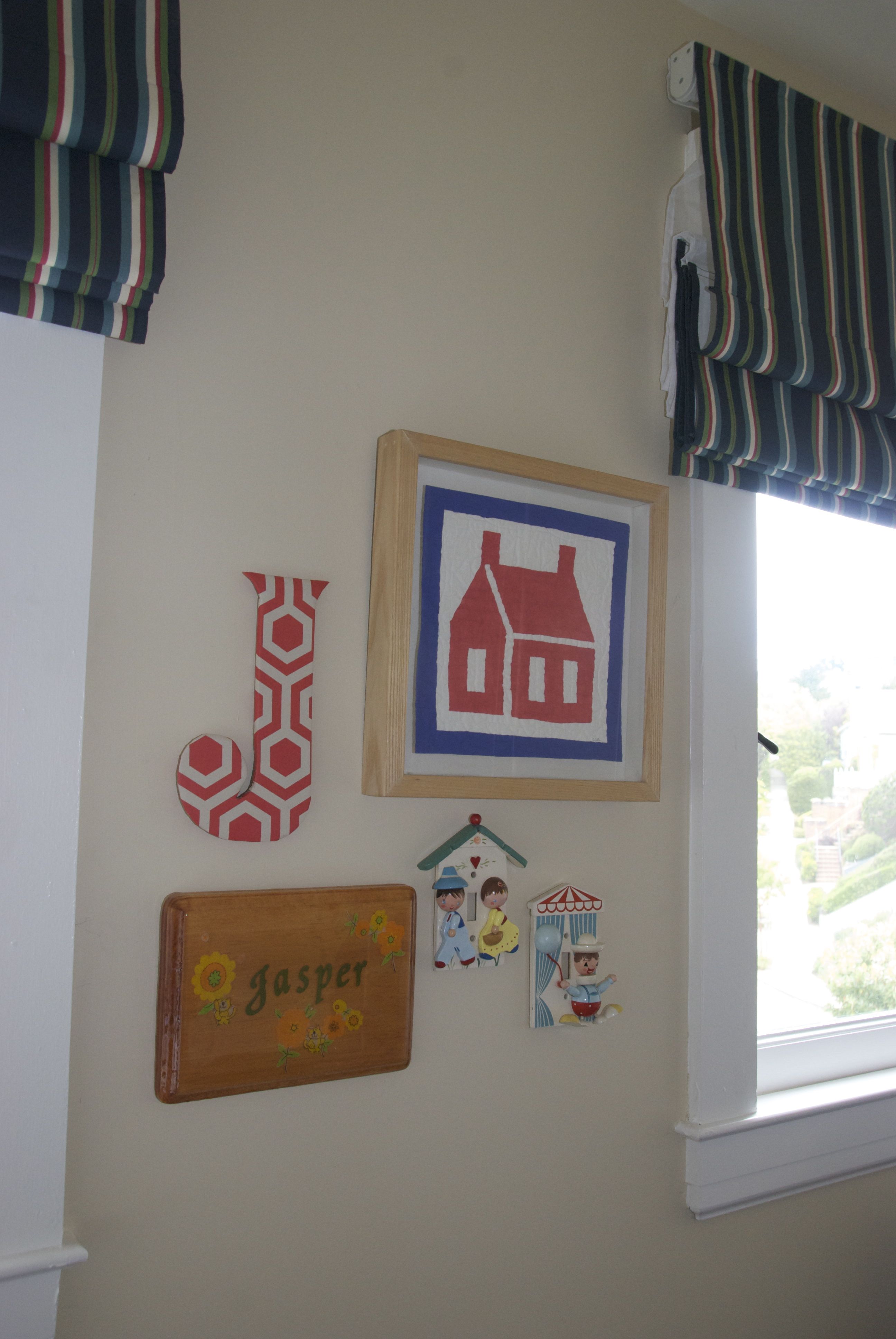
Here’s how one of them looked in the nursery:

J in nursery

“J” mixing nicely with some whimsical accents in the nursery.

Well, this month, I’ll make one for a Jewels at Home reader! They are 9″ high, and you can choose the letter (duh! You mean, you don’t all want “J”s?) and color. They are great for the wall or for a door.

To enter, just comment on any post (why don’t you try exploring the blog and comment on a post besides this one) between now and May 15. I’ll get the winner’s letter in the mail to you by the end of the month.

By the way, I promise not to use your information for anything other than sending the winner a letter – no spam, no sharing of your information.  I just want to thank my readers and encourage you to keep reading and sharing your ideas, too.

Thanks for all your support.  It has been a fun first month!

“Jewels”

Art Clips for Kids’ Fridge Gallery

Well, first of all, I never dreamed I would put a picture of our fridge in this blog. The whole kitchen is terribly dated and doesn’t reflect our style at all. However, it works, and given the cost of a kitchen renovation, we’ve decided to live with it for a while.

I’ve been trying to spruce the space up a bit and add some functionality – for example, I got a kitchen island cart that added just enough storage and counter space, as well as a small eat-in area for the kids. If you can’t afford a renovation right now, it’s definitely a good option, and there is a huge range of size and styles.

Sometimes, it’s the little things. It sounds a bit silly, but even though we are living with the pink (yes, you read that correctly) counters and floor and the impractical cabinet layout, we were really missing having a place to display our kids’ art. Like a lot of fridges, ours does not hold magnets. And I only wish this were because it is cool stainless steel – no, it’s 80s/early 90s black.

I will credit hubby for coming up with the idea of using clips to attach art to the fridge. His “beta” version used plain clips and poster putty, which showed behind the clips and lasted about a month before falling off. I decided to take his idea and “Jewels-ify” it with some improved engineering and design.

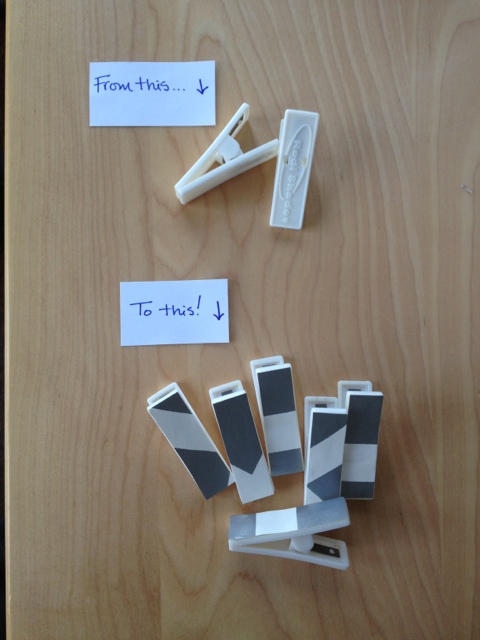
I started with plastic clips leftover from the temporary shades we had everywhere when we moved in. They are great for this project, because they are small and lightweight. The spring is not as strong as a clothespin, which makes them easier to use when attached to a surface.

I cut out strips from scraps of our Imperial Trellis wallpaper to fit the clips. I think it would have worked to cut random strips, but I tried to make patterns like stripes, “V”s, and zig-zags. This wallpaper went in the powder room and living room bookshelves. It has been the Energizer bunny of home decorating for me – it just keeps going and going! I’m totally in love with the elegant, classic, clean-lined pattern and the glow of the silver.

covered clips

plain plastic clips covered in wallpaper. I used hot glue, because the clips are not flat. (By the way, someone really needs to teach me some photo editing, so I can do proper "before and after"s!)

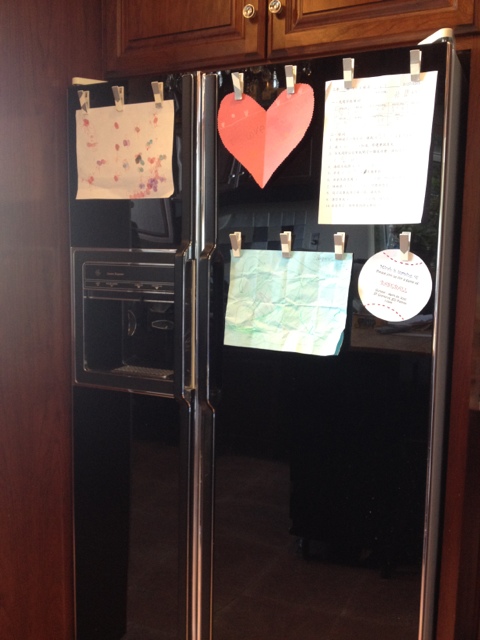
Finally, I used command adhesive strips from 3M to attach the clips to the fridge, and now we have a place to hang artwork and reminders! Yay!

20120429-075750.jpg

command adhesive strips to hold the clips on the fridge.

art on fridge

Finished fridge gallery.

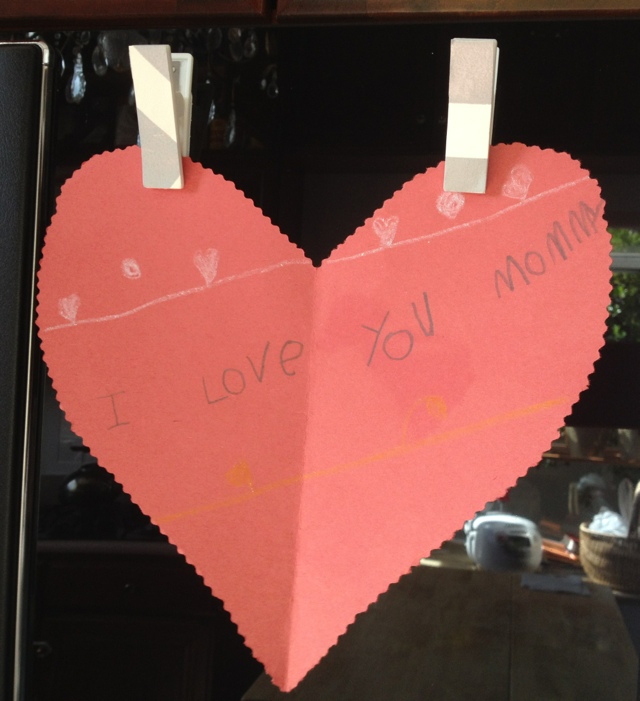
20120429-155931.jpg

Close-up: how happy am I to look at this every day?!

I think these clips would also work on a door, art display board, or wall, not just on the fridge, so give it a try and send a picture of your results!

What a good feeling to have at least one thing in our kitchen that I enjoy looking at!

“Jewels”

Growth Chart Ideas: Where Did the Time Go?!

My dear friend Cathy just gave me a challenge: she’s moving out of the house her family has lived in for many years and wants to preserve her children’s heights recorded on a door jamb. Here is her treasured growth record. You can see why she doesn’t want to leave it behind. I used to babysit her youngest when he was five, which is the lowest mark in this picture, and I can hardly believe that he has grown so much! Where did the time go?!

Cathy has been recording her three boys’ heights on this door jamb for ten years!

I’d love to hear your creative solutions to this dilemma. I’m also wondering how many people have all their kids heights combined in one place like this and how many have individual charts for each child. I can see the benefits and downsides to either approach. Here are some of my ideas, including the growth charts I sewed for my kids.

1) Transfer the entire jamb: You could remove the piece of wood with the markings and replace it. In the new house, it could be installed in a doorway or hung on a wall. This would allow you to retain all the quirky charm of the original – with the different colors and handwriting over the years. I personally think this would look so sweet as a piece of “art” in a family room or kitchen. (However, I think Cathy is going to be reluctant to pursue this idea, as she’s sort of worn out on DIY projects after prepping their house for sale.)

growth panel

This family recorded their children’s heights on a piece of wooden paneling. When they moved, they removed the plank from the wall and hung it in their new home (quite a surprise for the buyers of their old house!).

From: Like Mother, Like Daughter blog

2) Take photos and transfer: Like everyone else who has a smart phone, I find myself taking pictures of everything – usually five pictures of everything…. at least five times a day. All this picture-taking can get a bit ridiculous, but it also has its uses. I love the idea of taking photographs of the door jamb – it would probably take five or so photos to capture it all. I was trying to think of ways to keep track of the scale, so you can reproduce it accurately. One way would be to mark off 10 inch sections and take a picture of each section on its own, so you know it’s to scale if you print an 8″X10″ picture. Another way would be to take some notes on reference points (eg. Junior was 4 feet tall in May 2007), to help you work out the right size later. Once you have printed out your pictures to scale, you could

  • frame them, either in several simple frames stacked one on top of each other or in a long frame, designed for posters
  • decoupage them onto a wooden board or a new door jamb. This option requires no construction work (which I am sure Cathy will appreciate!) and would still capture the personality of the original. For this project, print onto plain paper, rather than photo paper.
  • make iron-on transfers and display on a piece of fabric.

3) Transfer the information to a new growth chart: Cathy did this the last time she moved, transferring the heights to a piece of masking tape, which is a great idea! Once you have the information, your imagination is the limit for ways to display it. There are so many beautiful ideas for growth charts out there, but here are some of my favorites, including what I did myself. A tutorial for making my growth chart will be in an upcoming post.

  • plain plank of wood – this would be easy, inexpensive, and give the new record a similar feel to the original door jamb. You could paint the wood first or leave the wood grain.
  • purchase a ready-made growth chart to hang. These come in endless variety made from wood, fabric, or paper.
  • wall decals – decals are such an easy way to make a beautiful statement in a room. I customized a tree branch decal in our nursery. There are dozens of gorgeous examples of wall decal growth charts out there. I particularly love this one!
wall decal growth chart

Wallies Wall Play Woodlands Growth Chart

From: Fab Baby Gear website

And last but not least… Jewels’ hanging fabric growth chart!

20120429-065944.jpg

Jewels’ own hanging fabric growth chart. Tutorial coming up soon.

I’m sure there are similar growth charts out there, but I designed this one myself, keeping in mind that I wanted it to be

  • portable – so that we could take it with us when we moved (a feature this post proves is valuable!)
  • easy to store – fabric can be rolled up for compact storage and ironed later – wood, obviously, cannot, and paper could get folds and wrinkles – though you could wrap around a paper towel roll to minimize this.
  • complete – I wanted to be able to record my kids’ growth from birth to adulthood. Many ready-made growth charts stop around five feet. Granted, most tweens and teens may not have any interest in growth charts anymore, but their parents might, so I made mine go up about 6’2″, which is more than generous, if you could see how tall I am!

UPDATE 5/3/2012:  Here’s the link to the tutorial for making your own growth chart!

Please let Cathy and me know if you have more great ideas about how to preserve her treasured memories!

“Jewels”