New Style for an Old Boiled Wool Coat (Version 1)

It has been a while since I found my mom’s old boiled wool jackets and brought them home. I’m so happy I finally got around to reworking the first one into something more tailored and contemporary, so I can wear this sentimental coat every day.

Do you have an old coat you can’t bear to part with? Depending on your coat’s original design, you can alter it using these ideas, from simple to intricate:

  • Take in the side seams
  • Take in the back seam
  • add a gather or dart at the back waist
  • Take in the sleeve seams
  • Add darts or seaming in back and/ or front
  • Take apart and rework individual pieces

My original jackets are made by Geiger from Austria, bought about 20 years ago, and they’re very big and boxy. I have no idea how my mom carried off this look, as she was very petite, but in any case, the coats were ready for major alterations. I used a whole arsenal of tricks to create a new style on this first project, as you’ll see.

How to take in the sides of a boxy coat:

If you want to make a subtle change, you can take in the side seams without touching the sleeves, but for a radical change like mine, you’ll need to take off the sleeves, so you can take in the sides all the way from top to bottom. After prepping your coat by removing the sleeves or lining as needed, turn it inside out and put it on. Use pins or safety pins to shape the side seams the way you want them. You can flip it back right side out to see how it looks and adjust as needed (pictured below on left).

After pinning a shape you like, use some tailor’s chalk and a ruler to mark a new seam line and see along that line. (pictured below on right)

Try it on to check the fit and when you’re satisfied, trim the excess fabric.

Steps to altering a boxy old coat: taking in the side seams.  {Jewels at Home}

Steps to altering a boxy old coat: taking in the side seams.

How to take in the back of a boxy coat:

Similar to taking in the sides, prepare your coat by removing the lining if needed, turn it inside out and put it on. Use pins or safety pins to shape the back seam the way you like. You can flip it back right side out to see how it looks and adjust as needed (pictured below on left).

After pinning a shape you like, use some tailor’s chalk and a ruler to mark a new seam line and see along that line. (pictured below on right)

Try it on to check the fit and when you’re satisfied, trim the excess fabric.

How to alter an oversized jacket: taking in the back seam. {Jewels at Home}

How to alter an oversized jacket: taking in the back seam.

Adding a dart or gather to an oversized coat:

If you just need to add a little shape to the back of your coat, you can add a simple dart or gather. Because my original coat was so boxy, I did this in addition to taking in the back seam. Looking at the back seam, fold in a small amount from each side. Use pins or safety pins to hold down the fold and try it on. Adjust as needed and then sew in place. I sewed this part by hand, so the stitches wouldn’t show.
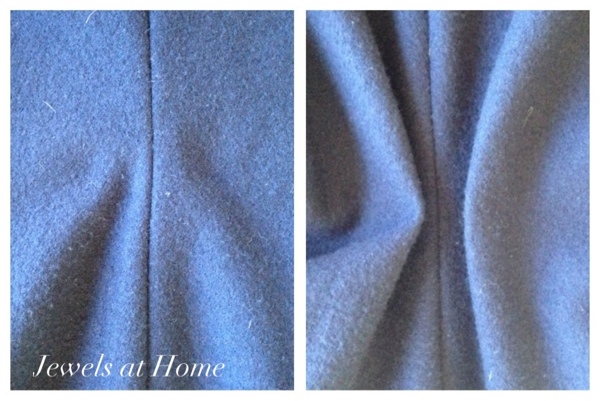
Steps to updating a boxy old jacket: adding a gather to the back. {Jewels at Home}

Steps to updating a boxy old jacket: adding a gather to the back.

How to take slim the sleeves of a boxy coat:

After I had already removed the sleeves of my coat and taken in the side seams, I measured the new sleeve holes by marking the top of the sleeve (top left picture below) and pinning it to the shoulder of the jacket and pinning the entire sleeve in place, so I could see how much needed to be removed from the bottom seam (top right picture below).  Using that measurement, I trimmed the sleeves at the bottom seam to match the new smaller arm holes. I used tailor’s chalk and a ruler to slim the sleeves an even amount all the way down (bottom picture below).
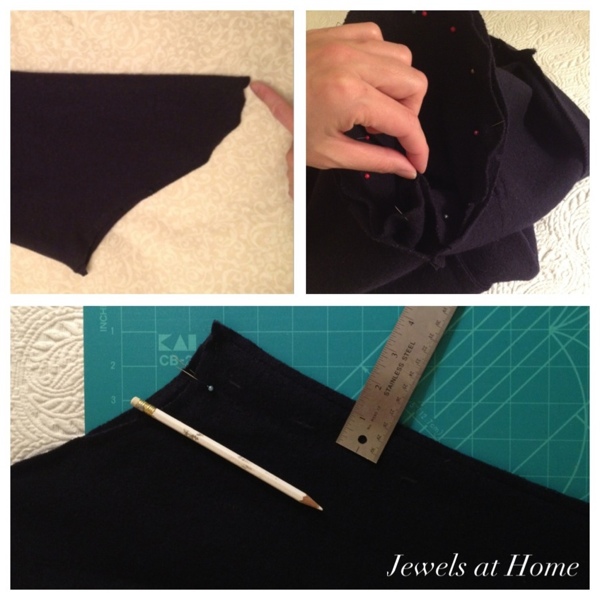
Updating an oversized jacket: taking in the sleeves. {Jewels at Home}

Updating an oversized jacket: taking in the sleeves.

After these steps, I had a jacket with a much better fit.

Step by step tutorial to altering an oversized and boxy jacket.  {Jewels at Home}

Results of altering an oversized and boxy jacket.

Adding contemporary style to an old coat:

I could have stopped at this point and had a comfortable fitted coat, but it felt so plain, and I wanted this to be a piece of clothing I’d love, so I decided to remove the old notched collar and use the lining material from the coat to make a larger collar. Finally, I added some more buttons, and I had a look that is completely new and I’d be happy to wear every day.

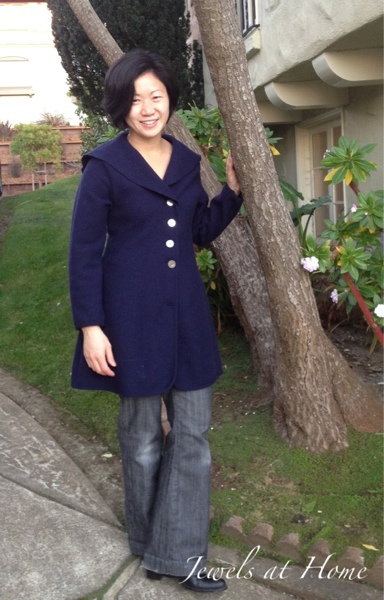
Complete steps to tailoring a boxy oversized coat. {Jewels at Home}

Complete steps to tailoring a boxy oversized coat. {Jewels at Home}


I’m so pleased with my “new” coat, that is filled with memories of my mom, and I’m looking forward to tinkering with the next one to create another cozy memory to wear.

“Jewels”

Felt Christmas Trees

Here is the second group of Christmas trees I made for our mantel this year.

I haven’t put up any of the trees yet – I love Christmas, and I’m definitely catching myself singing along to the carols in stores, but I’m trying to enforce a little discipline at home. Besides, we’ve had some warm spells this November, so I might as well finish soaking up fall before celebrating winter!

I was originally inspired to make a Christmas forest by the exquisite handmade Christmas trees by Shauna Mailloux, and for today’s trees, I found inspiration from the charming felt trees made by Rebecca at the Crafted Sparrow.

DIY forest of felt Christmas trees from Jewels at Home.

Just to remind you, here’s a picture of the first decorative Christmas trees I made. They were all quick projects created by winding yarn or trim around the cone.

Make your own decorative Christmas trees.  Easy, inexpensive, and unique holiday decor!  From Jewels at Home.

Make your own decorative Christmas trees. Easy, inexpensive, and unique holiday decor!

For the felt trees, I also used homemade tree bases formed by rolling used cardboard boxes into cones of varying sizes.

Make your own decorative Christmas trees.  Easy, inexpensive, and unique holiday decor!  From Jewels at Home.

As predicted, this second group of trees did take longer to make, but they were still very doable projects and absolutely worth the effort!

Felt triangle trees
These trees were the ones inspired by the felt trees made by Rebecca at the Crafted Sparrow.

I made the first tree using 3 full sheets of felt for a 14.5″ tall cone. I started by cutting two inch strips of felt and then cutting those into triangles (top left picture below). I saved a little felt to hide the cardboard under the first row and a small circle to finish off the top.

Because this tree sat flat on the ground, rather than on a trunk, I wrapped some strips of felt around the bottom 2 inches of the tree, so the cardboard wouldn’t show under the first row of triangles (top right picture below). I then glued triangles, overlapping slightly, in a row around the cone (bottom left picture below). Hot glue worked better than white glue, which just got absorbed into the felt. I worked the same way all the up the tree and capped off the top with a small circle of felt.

DIY felt Christmas tree tutorial.  From Jewels at Home.

A pretty tree, and I love this dark blue-grey color of felt.

DIY felt Christmas tree.  From Jewels at Home.

DIY felt Christmas tree.

The second felt triangle tree sits up on a glass bottle for a trunk. I’m thinking of filling it with some silver and grey beads. This tree was made the same way, except the first row of triangles hangs off the bottom of the cone (left picture below), since there is a trunk. For some variety, I made a narrower shaped cone for the white tree, and I added also some small pearl beads I had in my craft stash (right picture below). The cone for this tree is 13″ tall and used just over two sheets of felt.

20121119-205901.jpg

DIY felt and bead Christmas tree with a glass base from Jewels at Home.

DIY felt and bead Christmas tree with a glass base.

;

Felt circle tree

My friend and partner in crafting (crime), Ari, spotted these sweet felt trees from Land of Nod (and let’s be honest, what isn’t sweet at Land of Nod?!). The circles were not so hard to cut out – I used a Sharpie to trace a spool on a sheet of felt (top left picture below) and then pinned it to a second one, to cut out two sheets at once (top right picture below). This little tree used just over two sheets of felt.

Because the tree sat up on a base, I glued the first row of circles hanging just off the bottom of the cone (bottom left picture below). The cone was wider than the others, to change things up, and I decided to put a base on it, which was a large tin can wrapped in brown felt (bottom left picture below).

DIY felt circle Christmas tree inspired by Land of Nod.  From Jewels at Home.

;

Another cutie to add to the forest!

DIY felt circle Christmas tree inspired by Land of Nod.  From Jewels at Home.

DIY felt circle Christmas tree inspired by Land of Nod.

Here are some more pictures of the new felt trees and some of their old friends:


DIY felt Christmas trees by Jewels at Home.

DIY felt, feather, and yarn Christmas trees by Jewels at Home.

DIY felt Christmas trees by Jewels at Home.

I am hoping to get around some more trees this season, but we’ll see how things go, with some stockings and teacher gifts still on the to-do list. I’m enjoying getting warmed up for the season!

“Jewels”

I shared this project at:

Centsational Girl’s holiday Link Party

Make Your Own Decorative Christmas Trees

Don’t get me wrong, I pretty much love craft projects just for the joy of making something with my own hands. But, to be honest, there are DIY projects that look just like you DIY’ed them, those that turn out as well as something you would buy, and then there are those that turn out to be truly beautiful, unique pieces of art. When I saw these handmade Christmas trees by Shauna Mailloux, I knew they fell into the last category, and I couldn’t wait to try them myself.

There are a hundred ways you could customize these trees. I used a few of Shauna’s ideas and came up with some of my own, browsing the craft store and my own odds and ends. I encourage you to try making your own unique holiday creations!

Make your own decorative Christmas trees.  Easy, inexpensive, and unique holiday decor!  From Jewels at Home.

Make your own decorative Christmas trees. Easy, inexpensive, and unique holiday decor!

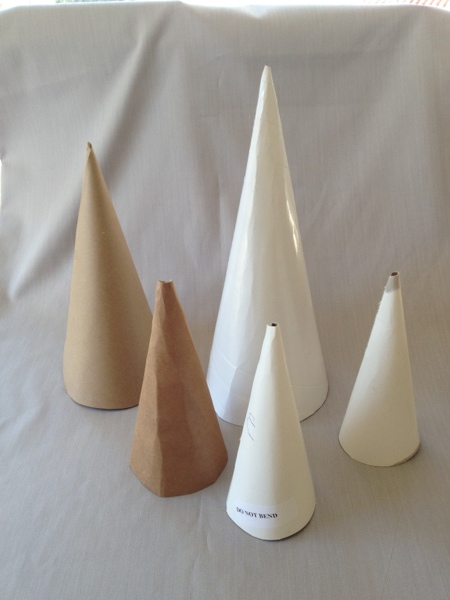
Like Shauna, I made my own tree bases by rolling cardboard boxes into cones of varying sizes.

Make your own decorative Christmas trees.  Easy, inexpensive, and unique holiday decor!  From Jewels at Home.

Here are the first few trees I made. (With some luck,) I’ll add more later. I call these the “instant gratification” trees, because they were quick and easy. The “blood, sweat, and tears” trees will take a little longer…

Feather boa tree
This is my absolutely favorite of Shauna’s trees. It has a great funky elegance. When i was looking for supplies, I wasn’t sure about the quantities of materials needed, so I’ll list what I used to help you with your sourcing.

For this tree, I used 4ft of feather boa for a 14″ tall tree. It was simple to tuck one end of the boa in the top of the cone and wind it around, securing it with some hot glue once in a while. You can leave quite a bit of space between the rows, since the boa is so fluffy. I used a white cardboard cone, in case any cardboard showed in between the rows.

Make your own decorative Christmas tree from a feather boa.  Easy, inexpensive, and unique holiday decor!  From Jewels at Home.

White feather boa Christmas tree.

Eyelash yarn tree
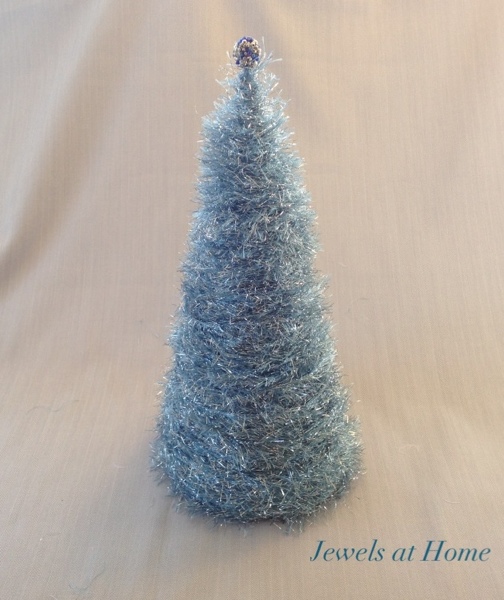
I loved the look of the white boa, but all the other boas at the craft store came in rather non-Christmasy colors. Luckily, this glitter eyelash yarn gives a very similar look!

Use glitter eyelash yarn to make your own decorative Christmas tree.  Easy, inexpensive, and unique holiday decor!  From Jewels at Home.

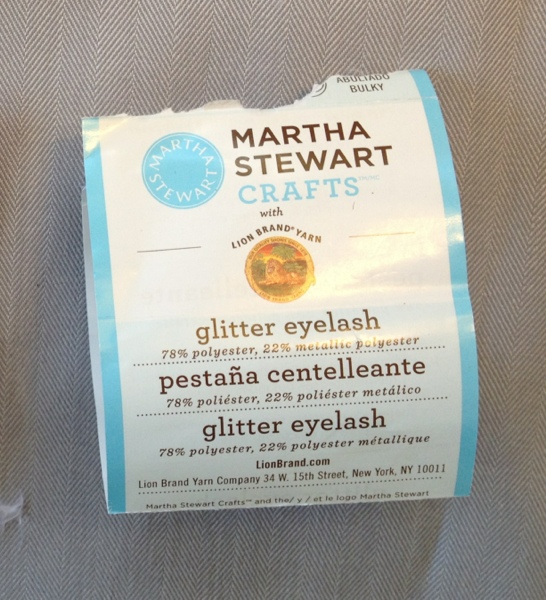
One ball (0.88oz ; 39 yards) of glitter eyelash yarn covered a 12″ tree. I used two strands (pulled the yarn from both ends) twisted together, as it’s actually very fine yarn.  The technique is the same – tuck the end in the top and wind the yarn around, but since the yarn is so fine, I used the toothpick end of my tree topper to help push it inside the cone.

I absolutely love this one, too!  The tinsel strands reflect light and make it sparkle.  I’ll show how to make the little beaded tree topper below.

Use glitter eyelash yarn to make your own decorative Christmas tree.  Easy, inexpensive, and unique holiday decor!  From Jewels at Home.

Glitter eyelash yarn Christmas tree with a beaded topper.

And then, there were two!

Use eyelash yarn or a feather boa to make your own decorative Christmas trees.  Easy, inexpensive, and unique holiday decor!  From Jewels at Home.

The fluffy ones! Feather boa tree and glitter eyelash tree.

Cording and braid trees

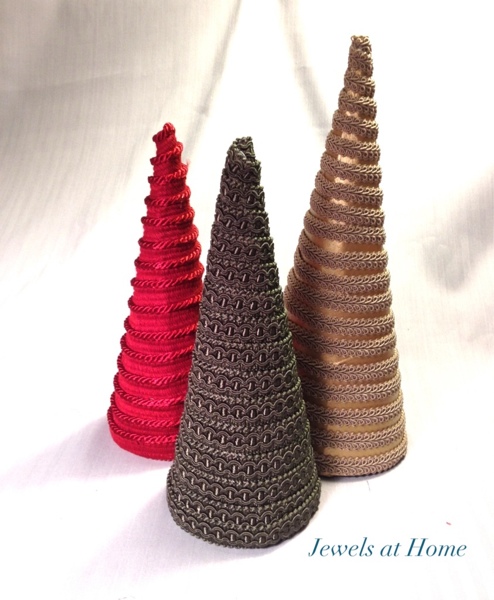
Not just for Marie Antoinette’s curtains, the trim section of our local craft store had some more great finds.  I found some cord in red and also these green and gold braids. Because of the lacy edges of the green and gold braid, I spray-painted the cardboard cones to match first. The rest is the same as the others, sticking the end in the top of the cone and winding around, with hot glue applied along the way.

In terms of supplies,

  • the red cord tree used 2.5 yards for a 9.5″ tall cone
  • 3 yards of the green covered a 9.5″ high cone, with a few inches to spare
  • the gold is a bit narrower, and I used 4 yards to cover a 12″ tree, with some space between the rows, as shown


DIY Christmas trees made with braided trims.  Easy and elegant Christmas decor.  From Jewels at Home.

DIY Christmas trees made with braided trims.

Beaded tree-topper

I also got this idea from Shauna’s trees, though she didn’t explain exactly how she made it, so here’s what I did.

  • Glue a large bead onto the end of a toothpick (top left picture below)
  • Spread tacky glue over the surface of your large bead (top right picture below)
  • Dip your glue-y tree topper into a bowl of small beads (bottom left picture below)
  • Insert the toothpick into the top of your tree.  Ta-da! (bottom right picture below)

Beaded topper for a small Christmas tree.  From Jewels at Home.

I have some ideas for more tree toppers, though I think that many of the trees look great on their own, too.


DIY Christmas trees.  Easy and elegant Christmas decor.  From Jewels at Home.

Fa-la-la-la-la-la-la-la-la!

“Jewels”


Kids’ Art Gallery Frames

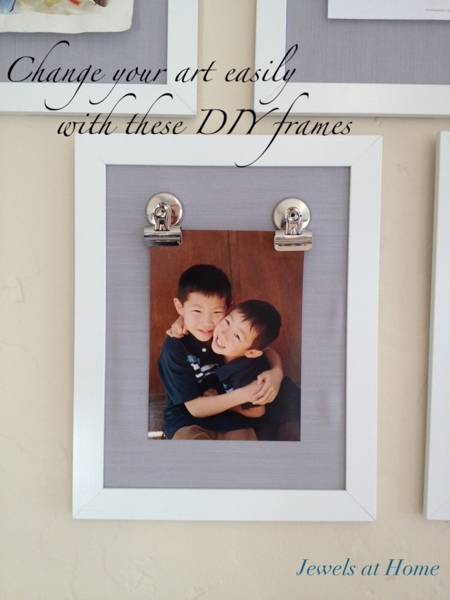
My kids’ art projects tend to accumulate in (not so) little plies all over our house. I’m implementing a new system to organize all of it, but more on that later. I would love to have more of their creations up on display, but I get around to it so seldom that the few pieces that are hung are completely outdated. I’ve been looking for a solution that makes it easy to change our our display, and I knew I had found it when I spied these frames with clips from Shanty 2 Chic.

I decided to make mine with fabric, rather than paper, backgrounds. The fabric matches these DIY picture mattes I made. I’ll show you how to make your own!

Change our your art easily with these DIY frames.  Jewels at Home.

Materials:

  • frames – I used NYTTJA frames from Ikea, which are perfect, because the front is plastic that has a protective film on it for packaging. I left the film on, so that if I ever want to use these are regular frames, it will be easy to peel off the fabric.
  • fabric or decorative paper
  • magnetic bulldog clips

Instructions:

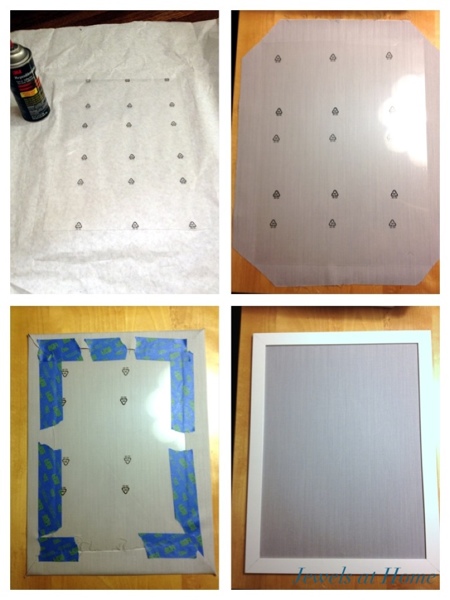
  • Take apart your frame and spray the glass (or in this case the plastic) with spray adhesive. I think you could also use a glue stick, if you spread it thinly. (top left picture below)
  • Cut out a piece of fabric (or paper) about 1.5″ wider than your glass in all directions. Lay the glass, adhesive side down, on the back side of the fabric. Cut the corners diagonally, to reduce bulk. (top right picture below)
  • Fold over the fabric and tape it in place securely. (bottom left picture below)
  • Reassemble your frame. (bottom right picture below)

Change our your art easily with these DIY frames.  Jewels at Home.

  • The last steps are to hot glue the bulldog clips in place and add your art! (pictured below)

Change our your art easily with these DIY frames.  Jewels at Home.

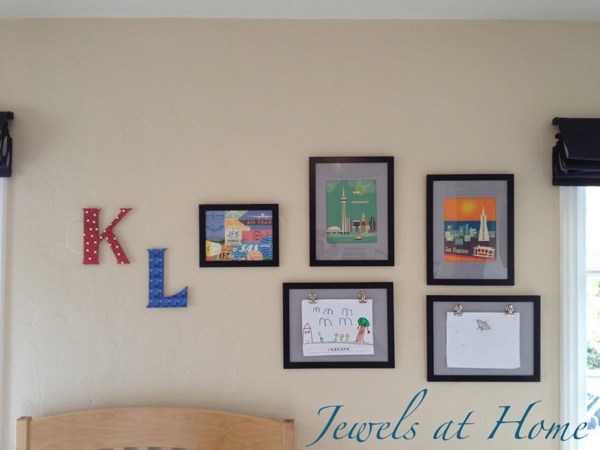
Here is the kids’ new art gallery in their room. I can tell already that I will be using these frames a lot! Also pictured are the DIY travel-themed pencil tins I made for them.

Change our your art easily with these DIY frames.  Jewels at Home.

Kids' gallery wall with DIY initials and frames with clips to change art easily.  {Jewels at Home}

DIY  frames with clips to change art easily.  {Jewels at Home}


Next up: I’m getting started on some projects for Christmas!

“Jewels”

DIY Fabric-covered Picture Mattes

Little details like art pieces are what bring personalty to a room and make it feel complete. Sometimes, it seems like I’m so busy battling piles of laundry and other basic necessities, that I will never get around to all these little details, but I’m always rewarded when I do! I finally put up the travel art for the boys’ room.

I decided to try making my own picture mattes by wrapping cardboard with fabric. You could do it with a large sheet of art or wrapping paper, too. One caveat is that cardboard can be acidic and could damage valuable art or photos, so this is not a project for your heirlooms. I turned the coated side of my cardboard towards the back, hoping that would protect the art a bit. This project turned out to be pretty easy, and I like how it looks. I’m also glad, because I have some other plans for this fabric in the room, and now it will all coordinate!

DIY fabric-covered picture mattes with tutorial.  Jewels at Home.

Materials:

  • light or medium weight cardboard, like cereal boxes or toy boxes. I think regular corrugated cardboard would be too thick and bumpy.
  • fabric or paper to cover your board
  • glue (glue stick and tacky or white glue) and scissors

Instructions:

  • Cut the cardboard to the size of your frame’s glass, and cut an inner shape to fit your art – you don’t have to do a simple rectangle or square; how about an oval? You also don’t have to center your opening; western-style mattes look great when the bottom area is slightly taller than the top, grounding your piece. Asian art is often centered with the top area slightly taller, representing the sky. (top left picture below)
  • Cut a piece of fabric about an inch wider than your cardboard in all directions. Use the glue stick lightly on the front to stick the cardboard onto the fabric. Instead of glue, you could also use Heat’n Bond Ultra Hold Iron-On Adhesive (top right picture below)
  • Fold the fabric around the cardboard, and use the white or tacky glue to hold it in place, clipping the corners. Do the outside first, and then the center. (bottom left picture below)
  • Ta-da! (bottom right picture below)
DIY fabric-covered picture mattes with tutorial.  Jewels at Home.

Step-by-step tutorial for fabric-covered picture mattes.

Here are the art posters up on the wall in the big boys’ room.

DIY fabric-covered picture mattes with tutorial.  Jewels at Home.

Kids' gallery wall with DIY initials and frames with clips to change art easily.  {Jewels at Home}

Kids' gallery wall with DIY initials and frames with clips to change art easily.  {Jewels at Home}

And here are the newly framed pictures next to the DIY cardboard initials I made. This display wall is slowly coming together – I’ve got one more project planned!

Now, hopefully this motivation will carry over to my own bedroom gallery wall!

“Jewels”

Kids’ Reading Nook and Clubhouse

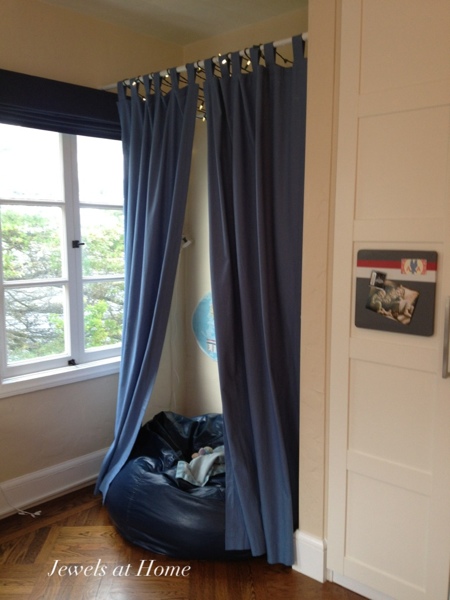
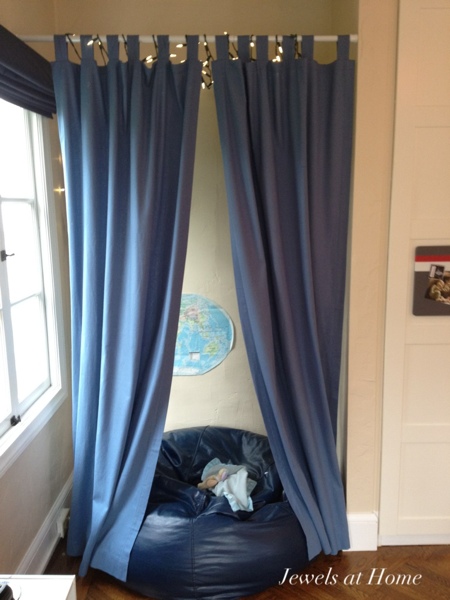
When we installed the Ikea Pax built-in closets, it created an alcove in the corner our boys’ room.  Some day, I think this might make a good place for a desk, but for now, it makes a cozy hideout for reading, games, and “K+L+J” club meetings.  This is an easy project, with a fun twist with its starry ceiling.

Materials:

  • 2 tension-mounted shower curtain rods
  • Tab-top curtain panels
  • String lights
  • Large floor cushions – we were lucky to inherit this great beanbag chair, part of our friend Victor’s bachelor decor that he had to part with when he moved in with Nicola 🙂
Great kids' reading nook with starry ceiling.  Jewels at Home.

Great kids’ reading nook with starry ceiling.

Great kids' reading nook with starry ceiling.  Jewels at Home.

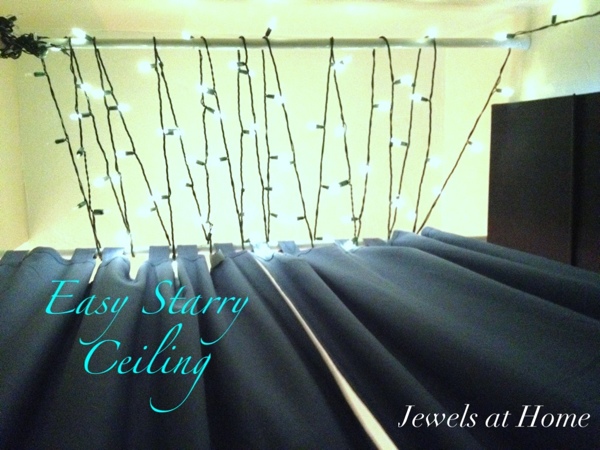
To close off the alcove, I mounted one tension rod at the front, holding the curtain panels, and the other at the very back of the alcove.  For the starry ceiling, I wrapped the lights around the two rods, weaving between the curtain tabs.

Easy starry ceiling for a cozy reading nook.  Jewels at Home.

Easy starry ceiling for a cozy reading nook.

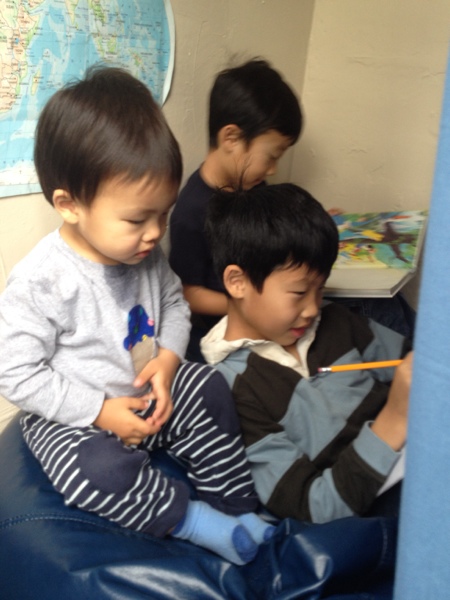
I’d like to add a few more things to the walls of the alcove, but for now, there’s a world map that fits with the other travel-themed decor in the room.  It looks like the boys are having a good time in their new space already!

Create a cozy kids' hangout with just a few simple materials.  Jewels at Home.

Create a cozy kids' hangout with just a few simple materials.  Jewels at Home.“Jewels”


Fire Station Play House

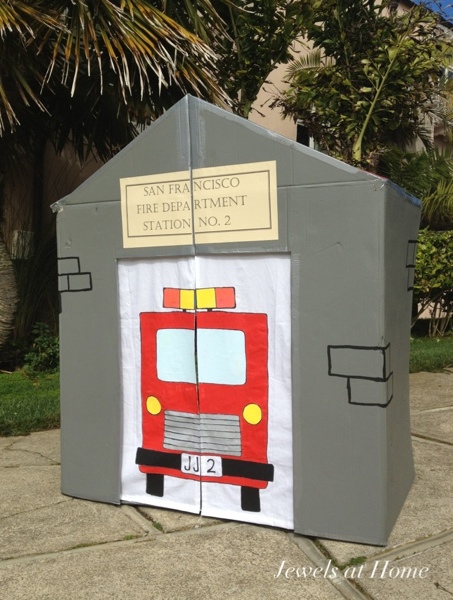
We are having a firefighter birthday for our youngest, and as part of the surprises and decorations for that day, I wanted to make him a fire station play house. I started by making a cardboard house that can be folded flat for storage and transportation. Then came the fun part of adding the fire station details – actually, making the house was pretty cool, too!

First, I painted the sides of the house grey, to match the duct tape. I had grey paint left over from painting the mid-century nightstand for our boys, and it matched well. For the roof, I picked up a deep red on sale at our local hardware store.

The details on the house were simple:

  • a few painted bricks to give the impression of a brick building
  • a fire hydrant painted on the side
  • a sign printed using Microsoft Word. The font is Castellan.
DIY fire station playhouse - it's foldable for storage!  Jewels at Home.

DIY fire station playhouse – it’s foldable for storage!

For the opening, I sewed two simple white cotton panels with velcro along the top and painted a fire engine. To draw the engine, I sketched half the truck on one panel and then used Sharpie marker to outline the drawing, and the marker went through to the second panel, so I got a symmetrical picture. I painted the design with acrylic craft paint and heat set it with an iron. The velcro is glued to the inside of the house with tacky glue. When the curtains are closed, it looks like the engine is inside, waiting for action!

DIY cardboard fire station play house.  Jewels at Home.

Curtains for DIY cardboard fire station play house. Draw your design on one panel using Sharpie marker, and the picture will transfer to the other panel in reverse.

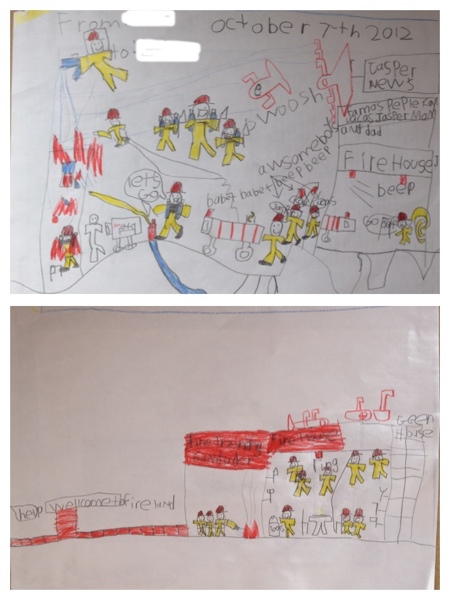
As a finishing touch inside the fire house, I “hung” these charming firefighter scenes that J’s brother drew for him.

DIY cardboard fire station play house.  Jewels at Home.

I meant to keep the house as a surprise for J’s actual birthday, but it isn’t that easy to hide a giant play house, so the boys are already having fun with it!

DIY cardboard fire station play house - it can be folded flat for storage.  Jewels at Home.

DIY cardboard fire station play house - it can be folded flat for storage.  Jewels at Home.

DIY cardboard fire station play house - it can be folded flat for storage.  Jewels at Home.

Many happy returns, baby J!

“Jewels”

Renter’s Dilemma: Covering a Large Doorway

My friend Christine has a dilemma. She’s renting a charming studio apartment with a kitchen that’s open to the rest of the space through a large double doorway. This doorway creates great flow in the small space, but it also allows the kitchen smells to permeate her whole home. Well, I would never want to slow Christine down in the kitchen, as I have tasted her cooking, and it’s yum!

Here’s the opening she’d like to be able to close off when creating something delicious in the adjacent kitchen.

Renter's dilemma: how to cover a large doorway.  Jewels at Home.

Renter’s dilemma: how to cover a large doorway?

I love a challenge, so here are four ways to cover a large doorway, including several I want to try or have tried myself!

1) Install salvaged or new doors in the opening.

Christine mentioned she was thinking of using some antique doors, and I love that idea! I definitely have my eye out for ways to use those, too. Some great sources include local antique stores, antique markets, craigslist, eBay, and in San Francisco,Building REsources, a non-profit that sells salvaged building materials.

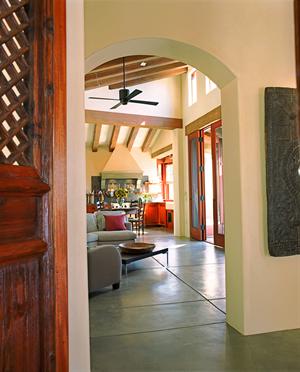
Using vintage materials is a beautiful way to honor an old home or bring character to a new one. I love the look of antique Chinese doors built into a new space, and I would like to incorporate something like this when we redo our kitchen and create a new opening to the dining area. Here’s a beautiful example spotted at Builder magazine.

antique Chinese door built into a new space.  Builders magazine.  Photo by Duncan Livingston.

antique Chinese door built into a new space. Builder magazine. Photo by Duncan Livingston.

Go to Builder magazine

My reservation about DIYing this beautiful idea is that it would require quite precise carpentry to make the doors fit and operate well. In a small space, swinging doors could also take up valuable space when open. If you are handy, check out these instructions from This Old House on how to fit those old doors.  I think I will be better off leaving that job to professionals.

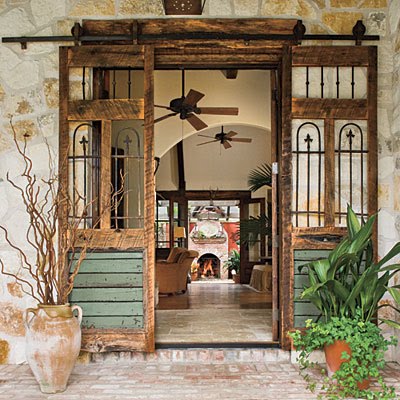
2) Install salvaged or new doors as sliding barn doors.

Another way to use old – or new – doors is to hang them sliding on rails in front of a doorway.  I would like to incorporate this ideas when (if?) we renovate, perhaps in our basement or in a kitchen-great room transition. It’s particularly well-suited to a large opening and has a casual charming feel. The advantage of using doors on a sliding rail is that they will take up less space when open. There are plenty of resources online for building your own barn doors and setting up barn door hardware.  It’s still a pretty advanced DIY project, but perhaps more forgiving than installing hinged doors. Also, for Christine’s purpose, this arrangement would let more odors through, but it should be an improvement on the current set-up. Here’s a beautiful example of sliding vintage doors from Lavender and Lilies.

Salvaged doors installed to slide on a rail.  Shown at Lavender and Lilies.

Salvaged doors installed to slide on a rail. Shown at Lavender and Lilies.

3) Install tall shoji screens fixed in place.

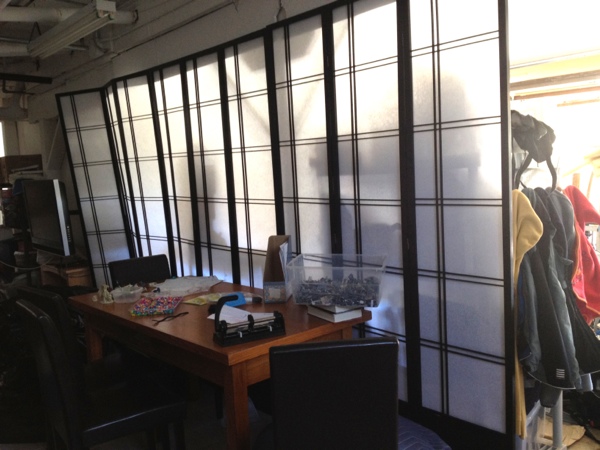
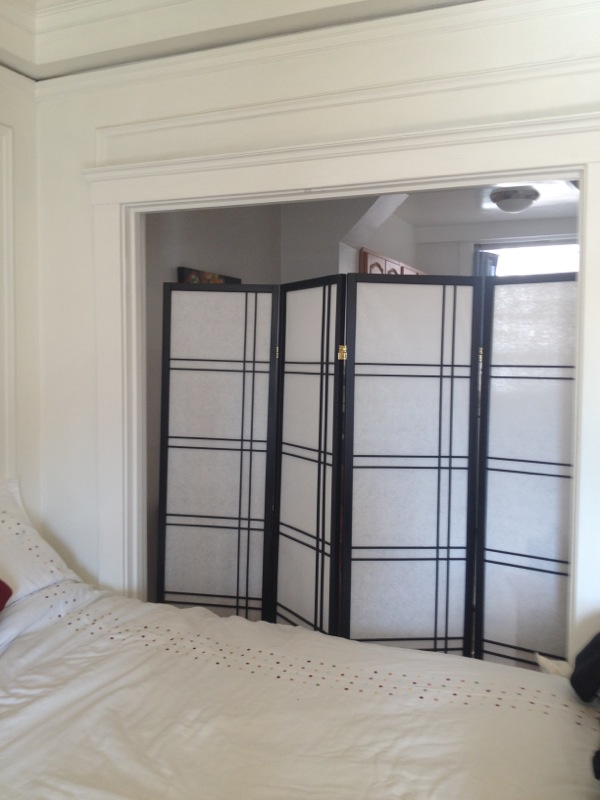
Christine and I must be on the same wavelength! Well, we do have quite a few things in common, you know… and now you can add that black shoji screen to the list. I bought a couple of these screens in a taller height from Overstock.  These are harder to find and more expensive but available in various heights up to 8′, which makes them very versatile. I installed them as a “wall” in our basement, which has a small living space that was completely open to the garage. I wanted to separate the two areas while still allowing light through. I also wanted something that would be economical, since, as mentioned just a moment ago, I dream of someday renovating that space and possibly incorporating some stylish sliding barn doors.  Please excuse the completely blog-unworthy photo below, as I did not clean up at all before snapping this picture.  On the left side of the screen is a small rec room type space for Steve and the boys to play games, etc..  On the right is our garage, and I have set up a rough mudroom area at the entrance.

Shoji screens in extra-tall heights can be used to create a floor-to-ceiling room divider that lets light filter through.  Jewels at Home.

Shoji screens in extra-tall heights can be used to create a floor-to-ceiling room divider that lets light filter through.

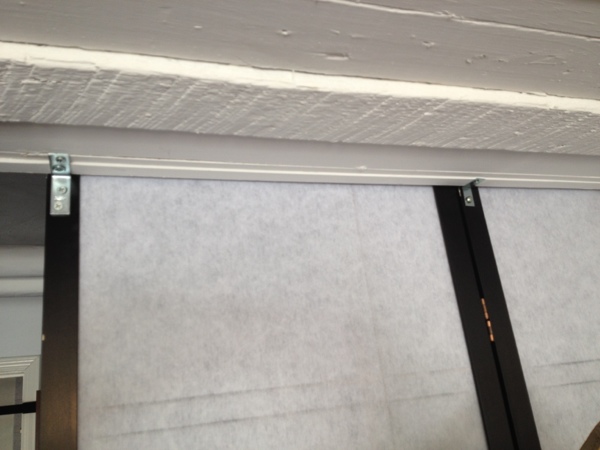
For now, I have these screens fixed in place with L-brackets on the back side. I left some panels free, so we can fold the wall open in certain areas. Installing tall screens would be an easy change to make at Christine’s place, and while it also would be permeable, I think it would still create better separation than a standing screen.  These screens fold very flat, so that would be another advantage for city living.

Shoji screens in extra-tall heights can be used to create a floor-to-ceiling room divider that lets light filter through.  Install by using L brackets screwed into the screen and the top of the doorway.  Jewels at Home.

Install an extra-tall shoji screen by using L brackets screwed into the screen and the top of the doorway.

4) Hang a heavy curtain.

Perhaps the easiest improvement of all would be hanging a heavy curtain over this doorway. It would take up little space, require minimal DIY skills, and be economical, too. Something heavy, like these grommet blackout panels would definitely cut down on air flow. You could hang these on a tension rod in the doorway or on a regular curtain rod on either side. I like grommet panels for the way they stack neatly.

Well, there’s some food for thought. Please share any other ideas for Christine in the comments!

“Jewels”

Chimchar and Monferno Pokemon Halloween Costumes

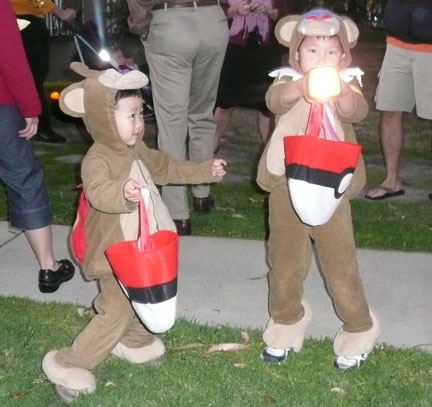
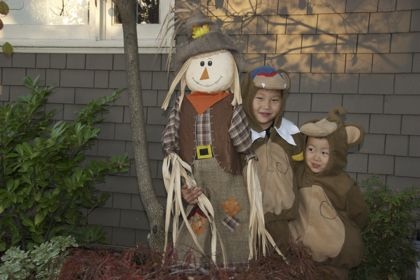
Halloween is not a major holiday at our house (when did it become a major holiday at all?), but of course, it’s fun to see the kids dressed up. I don’t make elaborate costumes every year, but there are a few I look back on with pride, including the fall the big boys wanted to be the Pokemon Chimchar and Monferno.  I lucked out finding good quality plain monkey costumes at Old Navy. They were fleece, so I bought fleece fabric to add the embellishments.

First, an overview of how the costumes turned out, next to the original characters.  Directly below is Chimchar and below him is Monferno.

Chimchar Pokemon costume.  From Jewels at Home.

Chimchar Pokemon costume.

Monferno Pokemon costume.  From Jewels at Home.

Monferno Pokemon costume.

Pretty good likeness, right?

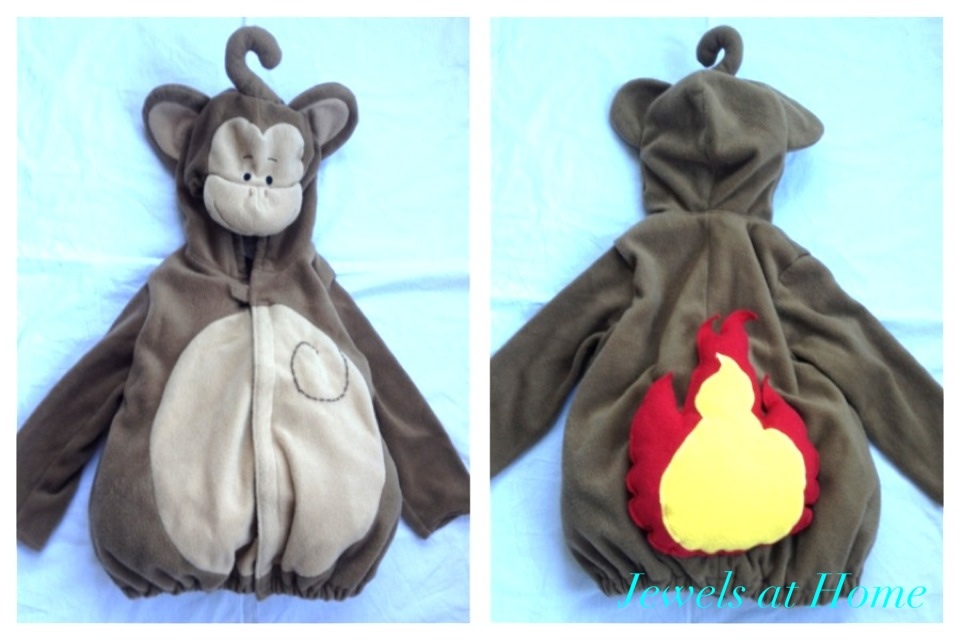
And here’s a breakdown of how I altered the monkey costumes to make the Pokemon.  For Chimchar, I

  • removed the tail completely.
  • sewed the tip of the tail to the top of his head, to make his little cowlick.
  • used brown embroidery floss to embroider the curl on his chest.
  • made a large flame for the tail using yellow and red fleece, stuffed it and sewed it in place.
Chimchar Pokemon costume for Halloween.  From Jewels at Home.

Details on a Chimchar Pokemon costume for Halloween.

For Monfernon, I

  • sewed a white collar out of two layers of white fleece and sewed it in place.
  • cut blue and red fleece for the face mask and sewed these in place with embroidery floss.
  • cut small white teeth and sewed these in place.
  • cut yellow bands and sewed these on the arms.
  • used brown embroidery floss to sew the curl on the chest.
  • cut off all but the base of the tail.
  • sewed a yellow and red flame tail with a layer of batting in the center and attached it to the base of the tail.
Monferno Pokemon costume for Halloween.  From Jewels at Home.

Details on a Monferno Pokemon costume for Halloween.

Since I was on a roll, I also made these pokeball bags out of felt and ribbon for the boys to go trick-or-treating.

Pokemon pokeball bags for treats.  From Jewels at Home.

Pokemon pokeball bags for treats.

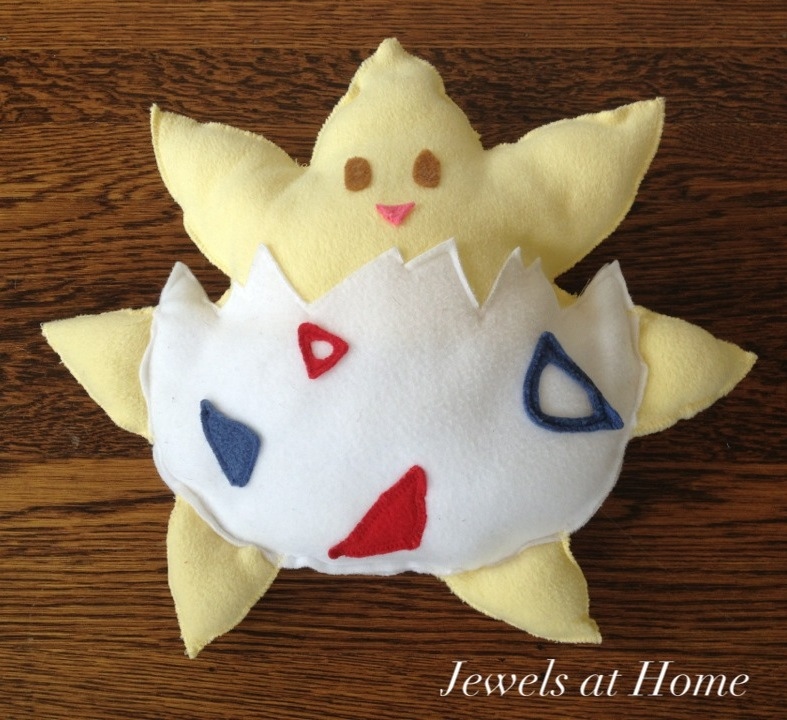
Steve and I dressed up as Ash and Misty, the Pokemon trainers.  I made this little Togepi Pokemon to carry around.

Togepi Pokemon doll.  From Jewels at Home.

Togepi Pokemon doll.

I don’t have detailed instructions here, but if you have any questions, please let me know.  I’d love to help you make your little Pokemon fans as happy as these guys!

Pokemon Chimchar and Monferno Halloween Costumes.  Jewels at Home.

Pokemon Chimchar and Monferno go trick-or-treating on Halloween.

Pokemon Chimchar and Monferno Halloween Costumes.  Jewels at Home.

Hope your October is full of treats!

“Jewels”

Quick and Cozy Fleece Blankets

Here’s the thing about the fog in San Francisco: you have to believe it is mystical and beautiful, or else you would just become horribly depressed. See that giant “cloud” at the base of Sutro Tower? Yes, that is fog. Brrrrrr.

Fog at the base of Sutro Tower, San Francisco.  Jewels at Home.

So, when we started planning an outdoor movie night for our oldest’s birthday party, I was a bit nervous, since the evenings are often chilly where we live. I decided to make fleece blankets for the boys to use during the movie, thinking they would also be great party favors. I mentioned in the post on alternative birthday gifts and favors that I like to give one or two larger items that can get some long-term use, rather than a lot of small disposable items.

There are a lot of ideas for fleece blanket projects out there. I was looking for something that would be substantial, easy to make, and still look great. That’s a tall order, and I was very happy to find this tutorial for an “Easy Peasy Fleece Blanket” from Polka Dot Chair. I made a few small changes when I did ours, and now everyone can stay toasty warm during our movie!

Supplies

  • fleece – 1.5 yards of two fabrics (front and back) for each blanket. I found some fleece on sale or as remnants at the local fabric store and bought the rest from fabric.com. They had the best price I could find, when you take into account shipping costs and clearance items.
  • scrap fleece or felt for monogram letters
  • Heat’n Bond Lite Iron-on Adhesive
  • Computer and printer for making letter templates

Applique letters

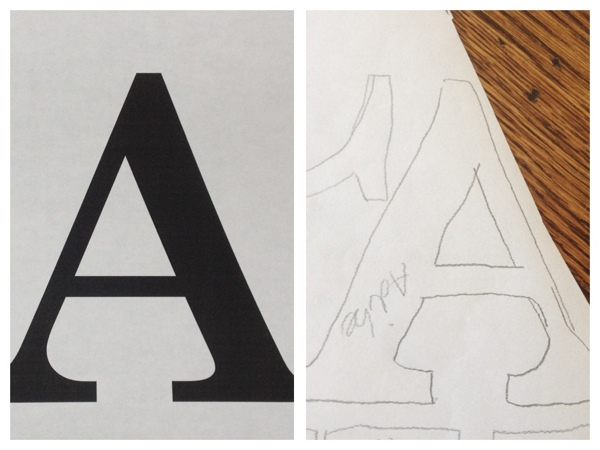
I can do appliques in my sleep after all the recent appliqued clothes I’ve made for the kids! I decided to do first and last initials for our monograms, since we had a few kids at the party with the same first initial. I printed the initials in Century Schoolbook font in 430 pt bold. I then traced them in reverse onto the Heat ‘n Bond. I held them up to a window to trace.

Monogrammed cozy fleece blankets from Jewels at Home.

Print out the letter templates and trace them in reverse onto the Heat ‘n Bond.

I ironed the Heat ‘n Bond onto the fleece, cut out the letters, and ironed the letters on to one side the blankets, using a press cloth. Because the fabric is so thick, it helped to iron again from the back, to get the letters completely fused to the blanket fabric.

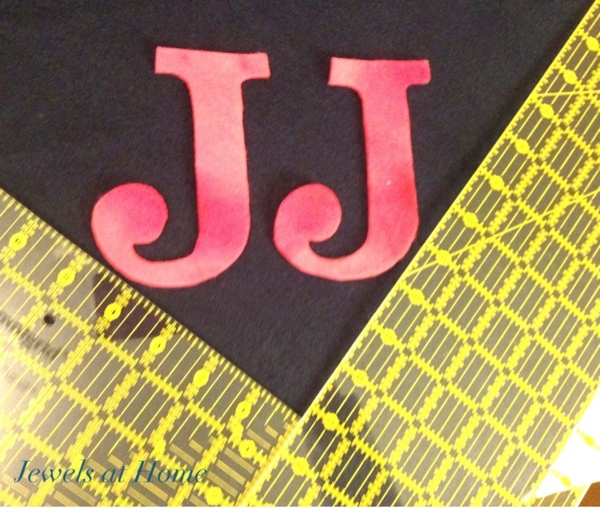
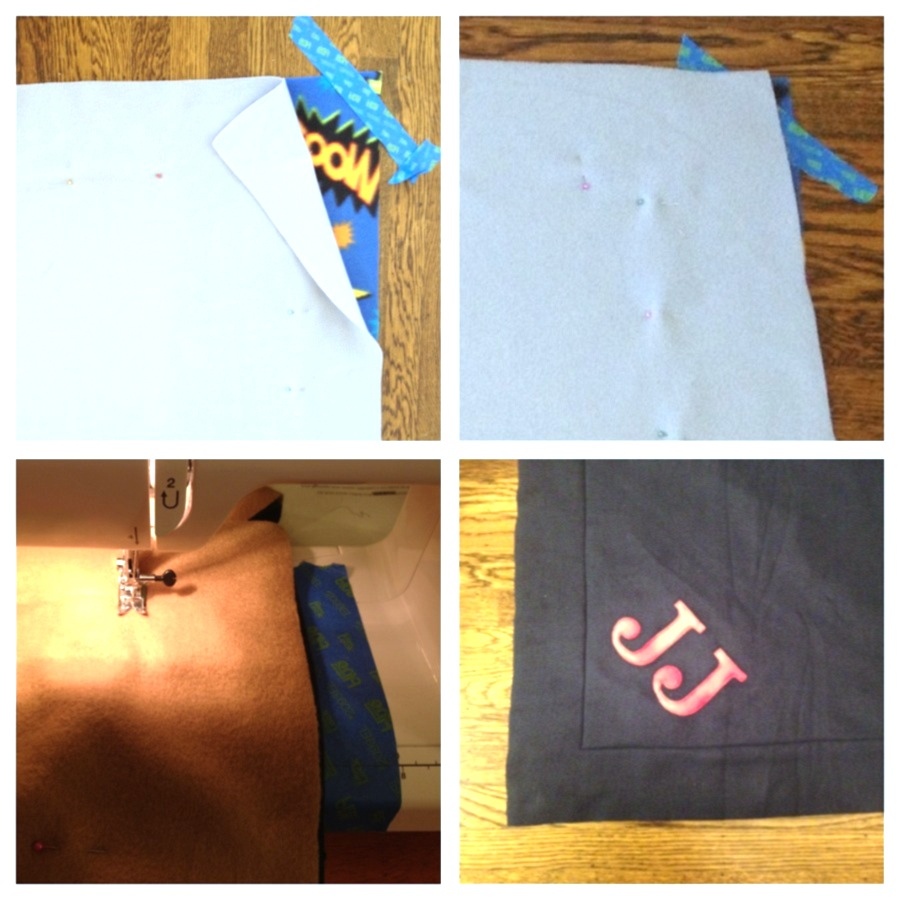
I wanted to apply the letters before sewing the blankets, so the stitching would not show through on the other side of the blanket. I had trimmed the fleece for each blanket already, so I knew the finished size. I then used rulers to mark off 5″ from each edge (3.5″ for the fringe and 1.5″ for spacing) and placed my letters in the corner (first picture below). I then sewed around each letter to secure it (second picture below).

Monogrammed cozy fleece blankets from Jewels at Home.

Iron your monogram in place in the corner. I measured 5″ from each edge, to allow for the fringe and some extra space.

Monogrammed cozy fleece blankets from Jewels at Home.

Sew around each letter to secure it to the blanket.

Blankets:

  • After choosing the fabric combinations, I laid out the top and bottom of each blanket and trimmed off the selvage and any other uneven areas. (top left picture below)
  • I then sewed the letters on one side of each blanket, as described above.
  • I pinned the two sides together (top right picture below).
  • Then, I sewed the sides together, with the seam 3.5″ from the edge. I found the easiest way to do this was to mark a 3.5″ seam allowance on the sewing machine using painter’s tape. (bottom left picture below)
Monogrammed cozy fleece blankets from Jewels at Home.

Lay out your fabrics, wrong sides together. Pin and trim. Sew with a 3.5″ seam allowance.

When I was done sewing, I cut strips about 1.25″ wide all around the blanket to make the fringe, stopping 0.5″ from the stitched line.

Here are the finished blankets. I love how each one is unique. The younger boys had fun prints on their blankets, and the older boys had solid fabrics or the graphic stars.

Monogrammed cozy fleece blankets from Jewels at Home.

So many ways to vary this simple fleece blanket design!

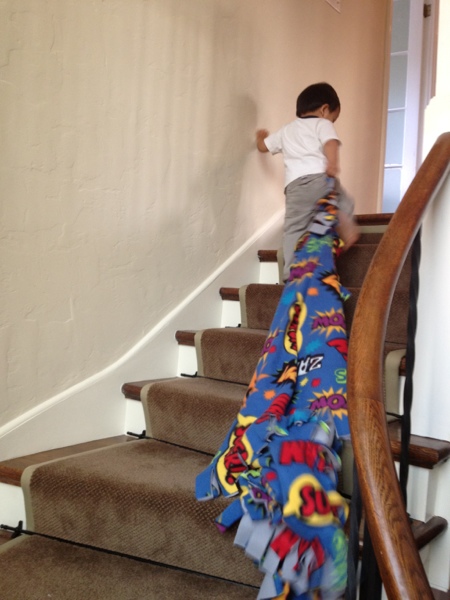
My younger boys were clamoring for me to finish their blankets, so they could use them right away!

Monogrammed cozy fleece blankets from Jewels at Home.

I like how Baby J’s firefighter blanket fits in with the rest of his nursery.

Colorful nursery from Jewels at Home.

Cozy fleece blanket tutorial from Jewels at Home.

And here they are one more time: cozy fleece blankets all ready for movie night! If I remember, I’ll take some pictures of the boys bundled up for the show.

Monogrammed cozy fleece blanket from Jewels at Home.

Yay! I wish I had the energy and fabric to make one of these for myself. I think I will have to wear a parka when we watch the movie…

“Jewels”