Growth Chart Ideas: Where Did the Time Go?!

My dear friend Cathy just gave me a challenge: she’s moving out of the house her family has lived in for many years and wants to preserve her children’s heights recorded on a door jamb. Here is her treasured growth record. You can see why she doesn’t want to leave it behind. I used to babysit her youngest when he was five, which is the lowest mark in this picture, and I can hardly believe that he has grown so much! Where did the time go?!

Cathy has been recording her three boys’ heights on this door jamb for ten years!

I’d love to hear your creative solutions to this dilemma. I’m also wondering how many people have all their kids heights combined in one place like this and how many have individual charts for each child. I can see the benefits and downsides to either approach. Here are some of my ideas, including the growth charts I sewed for my kids.

1) Transfer the entire jamb: You could remove the piece of wood with the markings and replace it. In the new house, it could be installed in a doorway or hung on a wall. This would allow you to retain all the quirky charm of the original – with the different colors and handwriting over the years. I personally think this would look so sweet as a piece of “art” in a family room or kitchen. (However, I think Cathy is going to be reluctant to pursue this idea, as she’s sort of worn out on DIY projects after prepping their house for sale.)

growth panel

This family recorded their children’s heights on a piece of wooden paneling. When they moved, they removed the plank from the wall and hung it in their new home (quite a surprise for the buyers of their old house!).

From: Like Mother, Like Daughter blog

2) Take photos and transfer: Like everyone else who has a smart phone, I find myself taking pictures of everything – usually five pictures of everything…. at least five times a day. All this picture-taking can get a bit ridiculous, but it also has its uses. I love the idea of taking photographs of the door jamb – it would probably take five or so photos to capture it all. I was trying to think of ways to keep track of the scale, so you can reproduce it accurately. One way would be to mark off 10 inch sections and take a picture of each section on its own, so you know it’s to scale if you print an 8″X10″ picture. Another way would be to take some notes on reference points (eg. Junior was 4 feet tall in May 2007), to help you work out the right size later. Once you have printed out your pictures to scale, you could

  • frame them, either in several simple frames stacked one on top of each other or in a long frame, designed for posters
  • decoupage them onto a wooden board or a new door jamb. This option requires no construction work (which I am sure Cathy will appreciate!) and would still capture the personality of the original. For this project, print onto plain paper, rather than photo paper.
  • make iron-on transfers and display on a piece of fabric.

3) Transfer the information to a new growth chart: Cathy did this the last time she moved, transferring the heights to a piece of masking tape, which is a great idea! Once you have the information, your imagination is the limit for ways to display it. There are so many beautiful ideas for growth charts out there, but here are some of my favorites, including what I did myself. A tutorial for making my growth chart will be in an upcoming post.

  • plain plank of wood – this would be easy, inexpensive, and give the new record a similar feel to the original door jamb. You could paint the wood first or leave the wood grain.
  • purchase a ready-made growth chart to hang. These come in endless variety made from wood, fabric, or paper.
  • wall decals – decals are such an easy way to make a beautiful statement in a room. I customized a tree branch decal in our nursery. There are dozens of gorgeous examples of wall decal growth charts out there. I particularly love this one!
wall decal growth chart

Wallies Wall Play Woodlands Growth Chart

From: Fab Baby Gear website

And last but not least… Jewels’ hanging fabric growth chart!

20120429-065944.jpg

Jewels’ own hanging fabric growth chart. Tutorial coming up soon.

I’m sure there are similar growth charts out there, but I designed this one myself, keeping in mind that I wanted it to be

  • portable – so that we could take it with us when we moved (a feature this post proves is valuable!)
  • easy to store – fabric can be rolled up for compact storage and ironed later – wood, obviously, cannot, and paper could get folds and wrinkles – though you could wrap around a paper towel roll to minimize this.
  • complete – I wanted to be able to record my kids’ growth from birth to adulthood. Many ready-made growth charts stop around five feet. Granted, most tweens and teens may not have any interest in growth charts anymore, but their parents might, so I made mine go up about 6’2″, which is more than generous, if you could see how tall I am!

UPDATE 5/3/2012:  Here’s the link to the tutorial for making your own growth chart!

Please let Cathy and me know if you have more great ideas about how to preserve her treasured memories!

“Jewels”

Oversized Letter Decor: Let’s Start at the Very Beginning…

… a very good place to start!

Art that features initials is so versatile. It looks great as part of a wall display, on a shelf, or on a door. It could make a great gift for a baby or child – it makes a kids – and the parents – feel so special to see their name on things!

There are lots of great ideas for projects featuring artistic initials, and I want to try them all! I decided to start with a simple 3-dimensional cut-out initial wrapped in paper or fabric. Here’s how I did it!

1) Buy or make a base letter: I’ve seen oversize wooden and cardboard letters at craft stores, so you could definitely start with one of those. In this case, I was feeling lazy and cheap – not to mention I do my projects when the kids are either napping or in bed at night, which makes trips to the craft store hard! So, I decided to cut out my own letters from cardboard. I had some extra-thick cardboard leftover from “dish pack” boxes from our move. These are great for lots of cardboard projects, because they are made from a double layer of corrugated cardboard and thus stronger and warp less.

You can find endless fonts by searching on the internet. I settled on Archive Garfield for a classic feel:

Archive Garfield

Archive Garfield upper case letters example from Myfonts.com

My Fonts website

Whole alphabet at Fonts.com

You could print out the letters you want, enlarge and then trace them, but I decided to wing it freehand. First, I decided on the overall dimensions I wanted – nine inches high – and marked that area on the cardboard. Then, I sketched the letters inside the space, using a ruler to make the straight lines. I also made some of the areas a little thicker than they are in the original font, so they would not be too fragile when cut out. I ended up using a popsicle stick to reinforce the thin part of the “K.” Also try to avoid narrow gaps – the inside curve of that “J” turned out to be tricky to wrap around. I used white glue on the very short tabs of paper and held them in place by wedging some bubble wrap in the gap until the glue dried. It turned out fine.

20120415-210502.jpg

Sketch or trace the letters onto cardboard using a ruler to help. Make sure the lines are not too thin and also try to avoid narrow gaps.

2) Apply paper or fabric: This is where you could get creative and use scrapbook paper, wrapping paper, maps, photos, fabric, whatever! I would recommend cutting leaving a one inch margin around your letter – I didn’t have that much, because I was using a scrap leftover from decorating the back of our little guy’s bookcase, which made it harder. Also, if you are using corrugated cardboard, I would just put a couple of spots of glue from a glue stick on the front, because if you glue it down thoroughly, the corrugation will show.

Cut tabs to help ease the paper around curves and corners and then glue down the tabs. Because I had a small margin, I needed to use some tape to help. Once I had the paper wrapped around, I used a popsicle stick with a little white glue on it to help smooth any areas where you could see the tabs, like around the curves.

20120415-212742.jpg

Lightly glue your letter to the back side of your paper or fabric. Cut out with a one inch margin (more than I had!) and cut tabs for the corners and curves. Glue!

3) Voila! and Finish! You could clear coat your letter with clear spray paint or Modge Podge. I wouldn’t do it with the corrugated, because, again, it would make the corrugation show through. It would be a nice finish for wooden letters, though.

20120415-220836.jpg

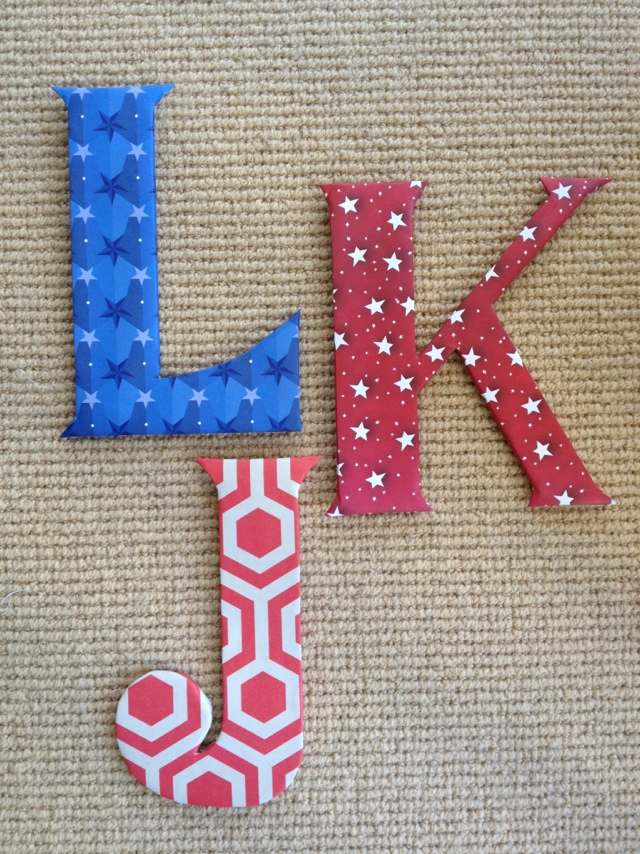
Finished product! A 3-D initial wrapped in beautiful paper.

4) Hang and enjoy! I’m using 3M Command Picture Hanging StripsEdit. These are very easy to use and have the additional benefit of adding more dimension to the letter, so it really stands out from the wall.

20120415-220903.jpg

3M Command (TM) Picture Hanging Strip – easy and removable!

This initial is for our youngest’s room as part of the wall collection below. The “quilt block” is actually made of paper and was a gift from my friend Penny many years ago. And the vintage nursery switch plate covers go beautifully here, too. The one on the left is mine from when I was little. The other one was picked up at a garage sale for $1. They can also be found on eBay for about $15-25. I didn’t really have a functional use for them, but I think they work perfectly in this display. This whole wall relates back to the other side of his room, where the same paper is lining the bookcase, and a vintage lamp from my childhood provides a reading and night light.

Nursery wall

The “J” in its place on the nursery wall.

And now, here’s a sneak peek at the other kids’ initials! I let them pick their own paper. I was thinking stripes, but I love how the stars turned out.

DIY paper-wrapped wall initials by Jewels at Home

DIY paper-wrapped wall initials for my boys’ rooms!

“Jewels”

Upholstered Chairs: Beautiful from the Back

I love such a love for beautiful fabrics! And why use just one fabric to upholster a chair, when you can use two?! The back of a chair is a great place to use a more delicate, expensive, or ornate fabric that might not be ideal for the seat, and the contrast between the two materials adds a lot of interest. I’ve seen great examples of this from some of my favorite designers:

Candice Olsen dining chairs

Candice Olsen used a contrasting fabric on the outside of these beautiful dining chairs. The blue ties the seat and outside together.

Candice Olsen Design

Sarah Richardson chairs

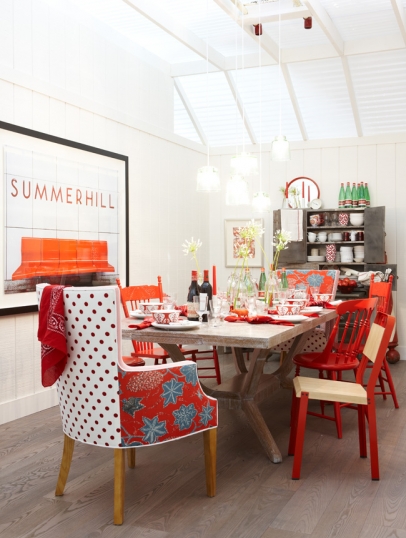
Sarah Richardson strikes a great playful note with these chairs upholstered in multiple fabrics. Again, the color theme - in this case, red - tie them together.

Sarah Richardson Design

So, I was looking around my house for a way to try this, when my eyes landed on a pair of green side chairs that we’ve had for many years as extra seating in our living room. They were originally dining chairs that worked well for saving space, and I cut down the legs to make them more comfy for lounging. Our new house can get dark, so I’ve been trying to lighten up our furniture, and I just happened to have recently bought this gorgeous floral fabric. I didn’t even have a specific plan for it, but I knew that I had to have it (did I mention, I have a weakness for beautiful fabrics?!) I spotted it on Fabricguru.com, which is my favorite online fabric store. They have great prices on remnants and an easy-to-browse interface. The downside is that a lot of the fabrics are discontinued or almost so, so if you need more down the road, it may be hard to find.

Floral Noir

Robert Allen Waldemere Contemporary Floral Printed Cotton Drapery Fabric in Noir

Here’s what happened when the old chairs met my new fabric:

floral fabric on green chairs

Waldemere floral fabric on the outside of green velvet chairs.

To apply the fabric, I experimented with our staple gun, but in the end, it worked best to apply the fabric with just a regular craft glue gun. I folded about a half inch “seam” around the edge and just glued it on. I was prepared to cover the edges – or staples, had I used them – with some piping, but I lucked out, and the panels had piping already, so it looked very finished with very few steps. I think you could retrofit a variety of existing chairs with some creativity and minimal upholstery skills.

For some more inspiration, check out these beautiful examples found by other bloggers:

Saks chair

Spotted by Caitlin Wilson at Saks.

Caitlin Wilson Design

K-desgn chairs

Chairs by K-design, spotted by Decorati.

Decorati Interior Design Blog

Go give it a try! It might take some adaptation to work on your particular chairs, but keep in mind using nailhead trim, piping, or decorative braid to hide staples and seams, creating a transition as you turn your chairs into eye-pleasing conversation pieces!

“Jewels”

This project is shared at:
handmade projects

Lining Bookshelves: Decorating Inside the Box

I’m always amazed at how easy it is to beautify a bookcase by decorating the back. There are lots of great examples out there of using paint, wallpaper, wrapping paper, or fabric.

In my most recent project, I wanted to add some color and personality to our baby/ toddler’s room. I was thinking of a solid red background for his shelves, but then I lucked out and stumbled upon this fun graphic paper from nineteenseventythree.com. At four dollars a sheet, I was able to cover the entire back of the bookcase for twenty dollars and have some gorgeous paper leftover for cardmaking or another art project. The company is based in Britain, but I found the paper at a local store, Lavish, in Hayes Valley.

Red wrapping paper on bookcase

Graphic red and white wrapping paper lining a nursery bookcase.

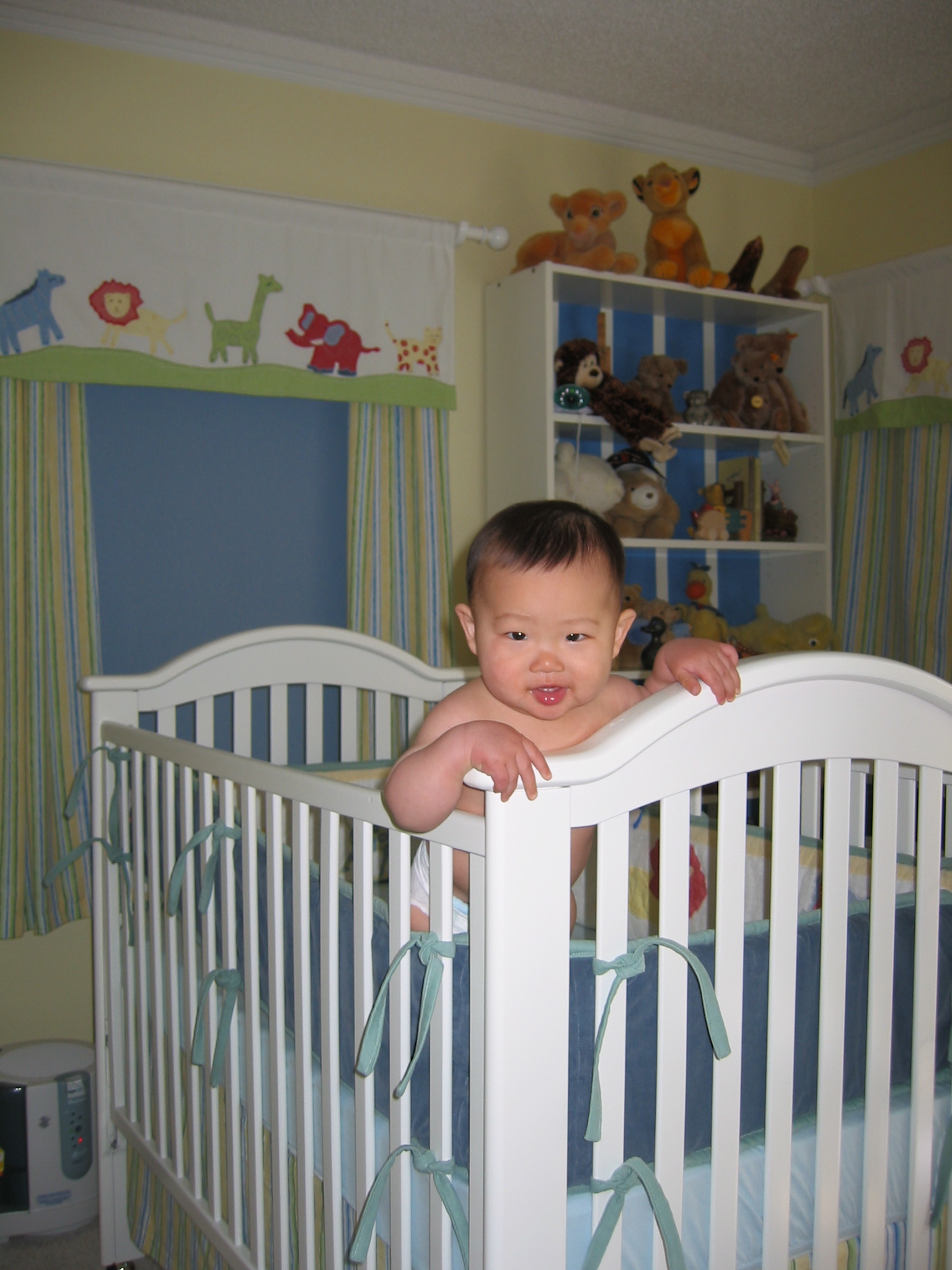
For our first’s nursery, I spray-painted the backs of old white Ikea bookcases with blue, masking off some white “stripes” with painter’s tape, and I loved that effect, too. I was able to take the back piece off to paint, which made it a lot easier. I never took a picture of the furniture specifically, so you will have to make do with a baby pic and the shelf in the background.

Blue and white painted bookcase

Blue and white stripes painted on back of nursery bookcase.

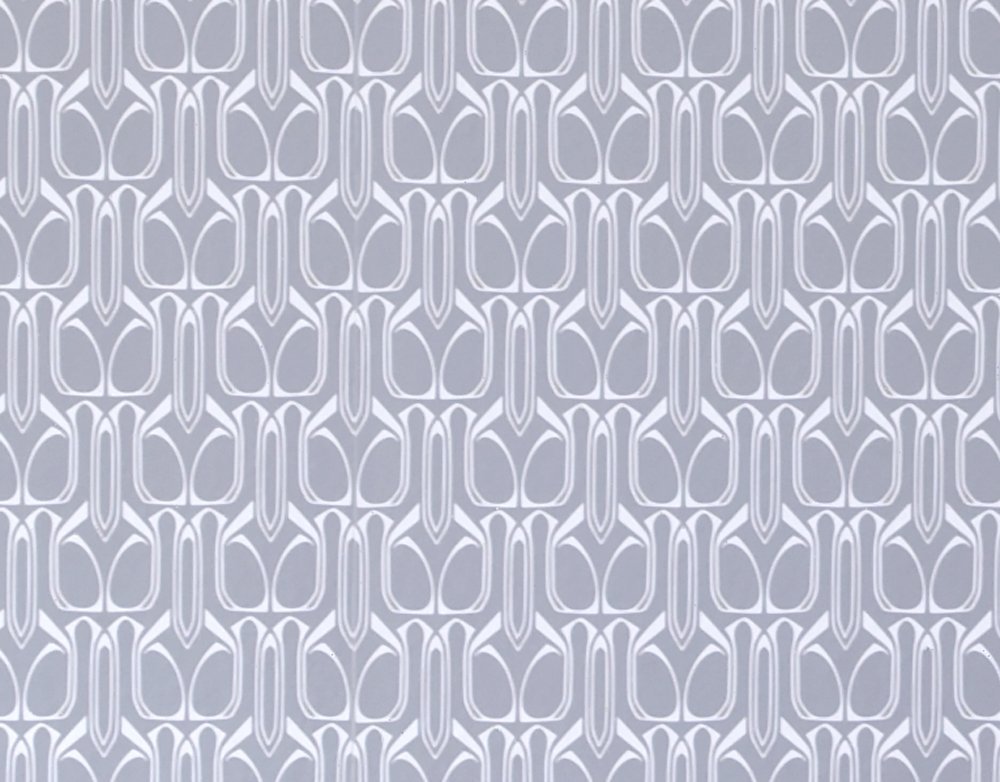
I think the nursery projects were my favorite results, but I’ve also experimented downstairs with our living room and kitchen storage. I went through a die-hard Arts and Crafts phase, when we bought a lot of very heavy wood pieces in that style. I still love these bookcases for their classic look and incredible quality, but I wanted to brighten them up for our current decor. I chose Imperial Trellis wallpaper in Silver by Schumacher for its gorgeous classic pattern and the glow of the silver. It’s pricey, but you need so little for a project like this that I bought a single (well, it comes as double, though you can find it sold as a single with a cutting fee) roll for this project and one wall in our powder room, and I will still have some left over. I have to say that the effect was not as dramatic as I hoped, because they are still very dark and heavy, but I think it’s a move in the right direction, and I couldn’t bear to paint or alter the shelves in any other way.

Imperial trellis wallpaper on bookshelf

Imperial trellis wallpaper in silver. (The bookcase styling needs some more work.)

Finally, I also applied some fabric to the back of some glass-front shelves in our kitchen. I got the idea, because I felt that our white bowls, cups, etc. were just “disappearing” visually in the white cabinets, so I wanted to add some color for a backdrop. It was a quick fix using fabric scraps from another project, but I think it’s an improvement!

Fabric lining kitchen cabinet

Green print fabric lining display cabinet in the kitchen.

Mounting tip: In the past, I have used 3M mounting strips of various kinds for attaching fabric or paper to the back of a bookshelf. With the wrapping paper project, I was eager to get started and didn’t have time to run to the store, so I just used blue painter’s tape, and it worked fine. Since the wallpaper came in small sheets, I also used tape on the back to join the pieces as I applied them. If you are using a heavier material – such as fabric or wallpaper – or a material that you want to preserve, the 3M strips are stronger and photo-safe (not that these are photos, but I assume that means they are not acidic, etc.). I definitely wanted the photo-safe for mounting on our Arts and Crafts style bookcases, for example. However, the blue painter’s tape is an easy and inexpensive tool, if you’re in a hurry and hanging something light and not-too-valuable.

More favorite papers:

Stunning temporary wallpaper for your next DIY project!

Tempaper Self-Adhesive Gio Temporary Wallpaper in Silver

Graham & Brown Trippy Wallpaper in Orange

710UvRChlgL._SL1500_

York Wallcoverings Silhouettes Fretwork Trellis Wallpaper, Mint Green/White

Hope you enjoy making your furniture look outside-the-box by decorating inside it!

“Jewels”

This post is shared at:

Lovely Crafty Home