Bib and Onesie Bouquet

To quote our toddler, “Wow! Wow! Wow!” My very dear friends Nicola and Victor just welcomed their first baby, and I was thrilled to meet her. I didn’t have a lot of time to pull together a gift, but I wanted something special, so I made this “bouquet ” out of onesies, bibs, and receiving blankets. I also brought some fruit and pastries from Whole Foods – goodness knows anyone eating hospital food will appreciate something fresh.

I know, I know, I had just sworn off appliqued onesies, but I had to give in just one more time, since I finally learned that the baby is a girl!  I had a few blank shirts left over from the DIY onesie party, so I quickly made some with a little girl in mind.  “Quickly” is the key word here, and our toddler was “helping,” so I apologize for the cupcake, which looks a tad squashed.  Hopefully, baby won’t mind.  Everyone will be too busy looking at her sweet face, anyway.
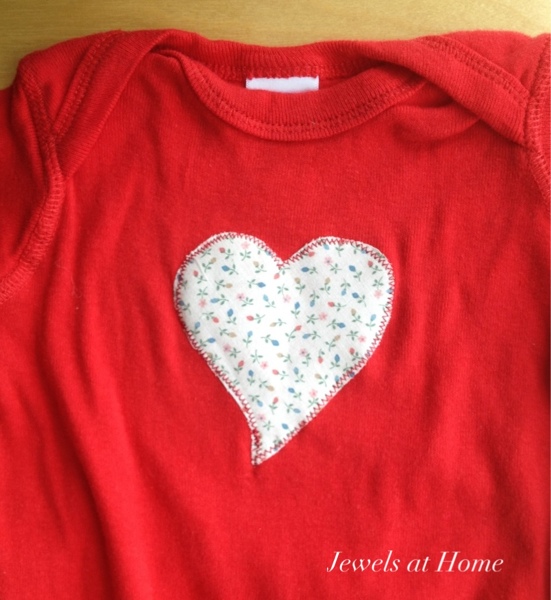
Sweet heart applique onesie.  Jewels at Home.

Sweet heart applique onesie.

Simple flower applique onesie for a baby girl.  Jewels at Home.

Simple flower applique onesie for a baby girl. The center is fleece from another project I’ll post soon!

Cupcake applique onesie.  Jewels at Home.

Cupcake applique onesie. A bit lopsided, oops!

Looking for beautiful onesies for your own bouquet? I have seen the most beautiful prints with big discounts on Zulily:

Materials for the “bouquet”

  • onesies (above)
  • bibs
  • receiving blankets
  • popsicle sticks
  • elastic bands
  • ribbon

The technique for rolling the “flowers” is similar for the bibs, onesies, and blankets.

  • Start by folding the bib or onesie in half.  For the receiving blankets, fold into a small rectangle. (top picture below)
  • For the bibs and onesies, I placed a popsicle stick in the center to make a “stem,” so the flower could be held in a bouquet.  The blanket made a a big enough roll  on its own.  (middle picture below)
  • Make a tight roll, with the center sticking out slightly more than the edges.  For the bib, it’s easiest to start with the strap, and for the onesies, it’s easiest to start with the neck, so that the center is not too bulky. (bottom picture below)
  • Put an elastic band around each flower, to hold it tight.
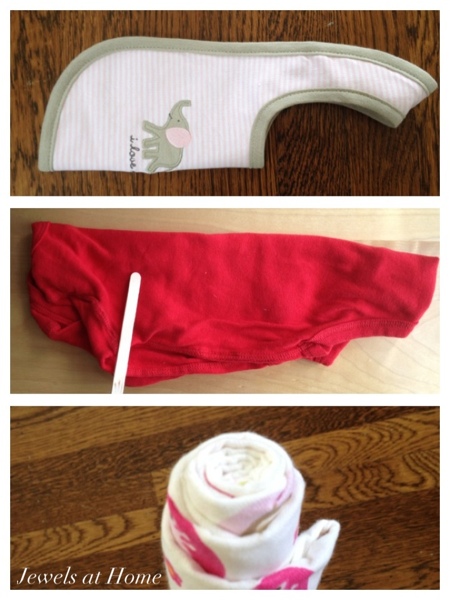
Rolling bibs, onesies, and receiving blankets to make flowers for a bouquet.  Jewels at Home.

Rolling bibs, onesies, and receiving blankets to make flowers for a bouquet.

To wrap the bouquet

  • Fold two receiving blankets into triangles, and laid them out with the edge of the top one slightly higher than the other.  (top picture below)
  • Make a pocket with the top blanket and lay the flowers inside.  (bottom picture below)
  • Roll the blankets around the flowers, and tie with a ribbon.
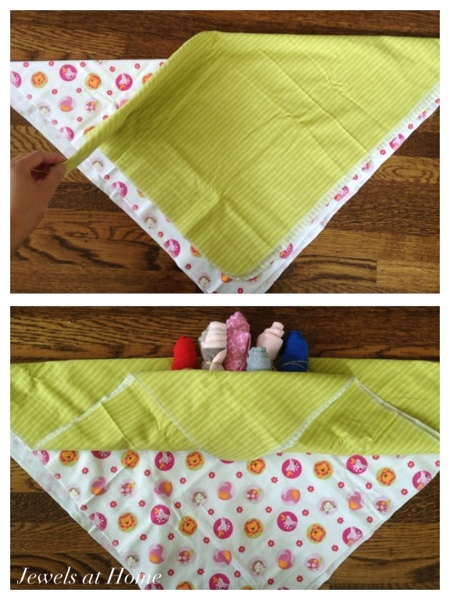
Wrapping bibs, onesies, and receiving blankets into a bouquet.  Jewels at Home.

Wrapping bibs, onesies, and receiving blankets into a bouquet.

Here are some pictures of the finished bouquet.  I think I could have fussed with it to make it a little neater, but I’m pretty happy with the overall result.
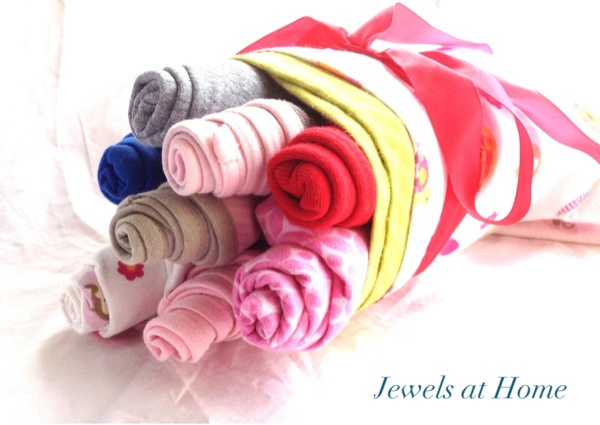
Tutorial: DIY bouquet of onesies, bibs, and receiving blankets.  Jewels at Home.

DIY bouquet of onesies, bibs, and receiving blankets.

Tutorial: DIY bouquet of onesies, bibs, and receiving blankets.  Jewels at Home.

DIY bouquet of onesies, bibs, and receiving blankets. It looks good next to this random bush outside the hospital. I’ll add some leaves next time.

And most beautiful of all, here’s the tiny recipient of this big bouquet!

20120917-195958.jpg

Welcome, little one!  I look forward to watching you grow and sharing many “mommy moments” with Nicola.

“Jewels”

Appli-crazy: More Inspiration for Kids’ Clothes

Yes, I know I tend to get carried away with projects, and there have been a lot of posts lately about different appliques on kids clothes. In this age of mass-produced everything, I really love the look of something unique on the little ones. Here are the other recent posts with ideas for decorating kids’ shirts and clothes:

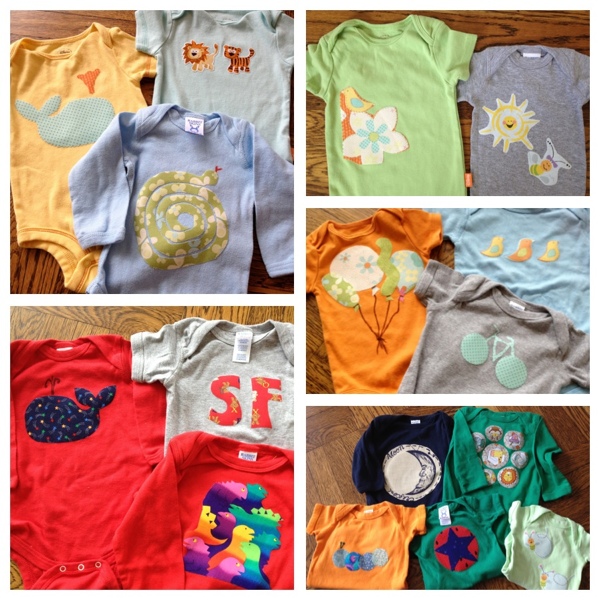
And here are some pictures of the last few shirts I’m making for a while – I need to get back to the rest of the house! I have had a lot of fun making them, and I think they have a unique and retro feel that’s very cozy. Again, I got the shirts and dresses from Rock Bottom T-Shirts, which seems to have the best prices around for blank items.

I made these for our baby, when I was preparing for the baby shower. I wanted them as examples of designs people could try, and I chose gender-neutral patterns, since we don’t know if Nicola and Victor are having a boy or a girl.

Lots of ideas for kid's appliques at Jewels at Home.

More ideas for kid’s appliques. I tried to make designs that would work well for boys and girls.

Make you own applique T-shirts.  From Jewels at Home.

Baby J sporting his DIY caterpillar shirt.

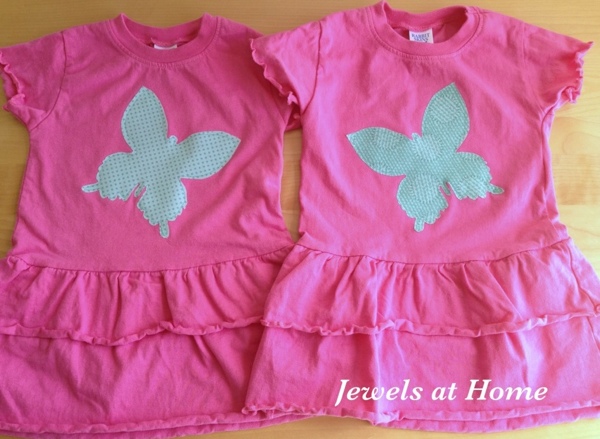
And for my twin nieces, I made these butterfly dresses. Twins are just twice as cute, especially my nieces, and I love it when they are in coordinated but not perfect matched outfits.

Add appliques to inexpensive blank dresses and shirts for a unique gift.  More ideas at Jewels at Home.

Add appliques to inexpensive blank dresses and shirts for a unique gift.

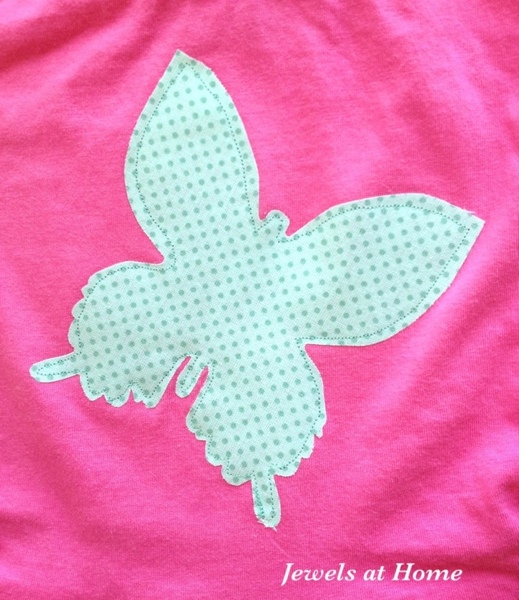
Butterfly applique for girls' shirts and dresses.  Many more ideas at Jewels at Home.

Close-up view of the butterfly applique for girls’ shirts and dresses.

I drew all the designs freehand, and the details on how to make the appliques can be found in the post for the Onesie Decorating Party.

While the girl appliques here turned out very feminine, I tried to make the others more neutral. It’s so challenging to find things that are truly gender-neutral these days, and with our house full of boys, I get a little tired of all the footballs and race cars sometimes. When I was growing up, it seemed like a lot more girls wore blue – it was my favorite color! Today, it feels like every color and every animal has been divided up between the genders, and there is very little overlap. I was talking about this with my friend Ari, remarking on how odd it is that cats are always for girls, giraffes are always gender-neutral, and dogs are always for boys… except for the poodles, she said. So true! Social conventions can be so odd, and I realize this is the least of it!

“Jewels”

Bench Made From Chairs

So, I’ve been a bit crazy for chairs this year…

First, I picked up this beauty at the antiques fair on New Year’s Day.

Living room vignette with vintage chair, painted chest, and new cushions.  From Jewels at Home.

Living room vignette with vintage chair, painted chest, and new cushions.

Then, I refinished these free Queen Anne chairs found through Craigslist…

Queen Anne chair makeover by Jewels at Home

Free Queen Anne chairs found through Craigslist: from worn and boring to fresh and elegant!

And I went on to paint and reupholster our dining chairs

Ikea dining chair makeover by Jewels at Home

Another step in the evolution of our old Ikea chairs. This new fabric gives them an elegant yet whimsical feel that fits in with the Chinoiserie/ Regency look I am working on in our living-dining room.

Along the way, I could not resist these traditional Chinese chairs, also a deal on Craigslist.

Solid wood traditional Chinese chairs.

Solid wood traditional Chinese chairs.

Suddenly, I had too many chairs… and I still wanted a bench for our front hallway. Do you sense a solution here? I did!

While you could certainly get clever with carpentry and join chairs together in a number of creative ways (side by side in a row; on either end with a board in between; with two chair backs turned 90 degrees to make the ends of the bench, etc..), I didn’t want to permanently alter these chairs, since they are well-made and beautiful and might move on to a new purpose some day.

Instead, I chose to strap the chairs together and use cushions to give the feel of a single piece of furniture.

Strapping the chairs together

To make the chairs work together as a bench, I started by strapping them together. I used felt strips that were 2″ wide and long enough to wrap around two chair legs with 2″ overlap. I put straps at the back of the chairs, at the top and bottom of each leg. Measure the top and bottom of the legs separately, since they might not be the same width.

In the picture below,

  • Because my felt was thin, I started by sewing two layers of fabric together. (top left)
  • Then, I sewed velcro onto each end of the strip, as shown: the hook side on one end, and the loop side on the back side of the other end. You could use 2″ wide velcro, but I just used the narrower strips I already had and put two strips side by side. (top right)
  • This is how the finished straps look with the ends joined. (bottom left)
  • Here’s how they work on the chairs. These simple straps held the chairs in line pretty securely. (bottom right)
Sew straps to link chairs together into a bench.  Jewels at Home.

Sew straps to link chairs together into a bench.

Cushions

I took off the three separate chair cushions and added a single big one. After going around and around with all the options for fabric, I chose this textured fabric that has shades of blue, green, and grey in it. It ties together a lot of elements in the foyer and living room and doesn’t compete with the design of the chairs.

I added two bolster cushions in this really fun print: Barber in powder blue by Premier Prints. The technique for making the bolsters was detailed in the tutorial on sewing pillows. I used two, rather than three, to take attention away from the three separate chairs. I’m thinking of ways to use some more of this fabric on the living room that is right off the foyer.

Storage baskets
Finally, I tucked these faux leather storage crates under the chairs for the boys to keep their school bags and library books, so these things don’t get lost.
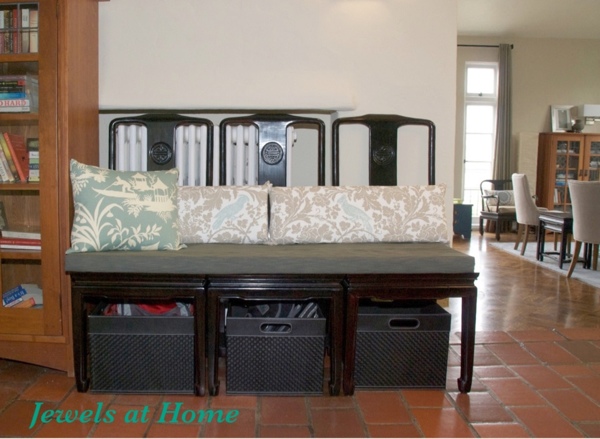
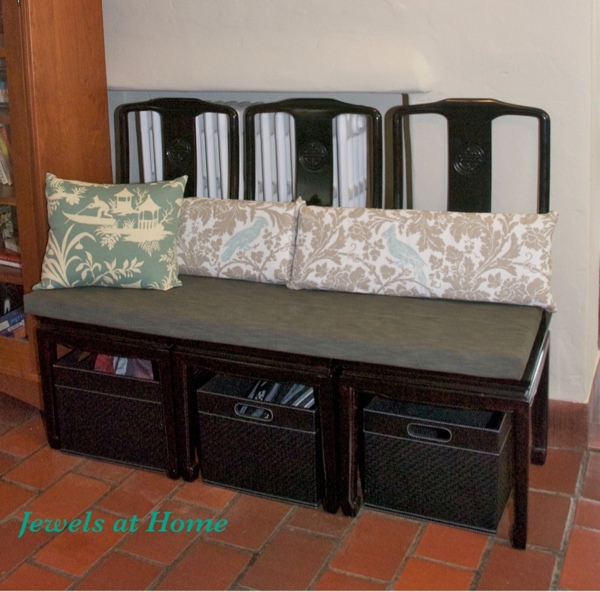
Finished “Bench”

Our new entry bench and storage system is working very well, and I like how it looks, too.

Ideas for joining chairs into a bench.  From Jewels at Home.

Ideas for joining chairs into a bench.  From Jewels at Home.

Ideas for joining chairs into a bench.  From Jewels at Home.

With a little bit of creativity, this “bench” has turned out to be a useful and attractive addition to our front hall.  Now back to some other chairs I picked up for free on the side of the road…

“Jewels”

DIY Pencil Tins: Desk Set

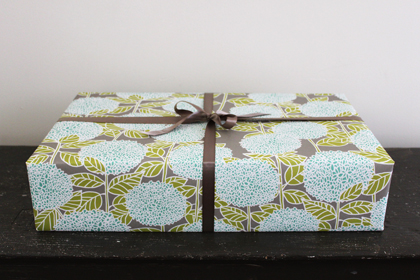
I recently picked up some beautiful wrapping paper at Lavish in Hayes Valley. This is the same store where I found the perfect red and white graphic paper for lining our nursery bookcase. The new paper I found is for my craft room. It’s called Hydrangeas by Kate & Birdie. This company has lots of very sweet original prints – my six year old bought himself a sheet of pirate ship paper while we were in the store. They started in Winnipeg, Canada, so even dearer to my Canadian ex-pat heart.

Kate and Birdie Hydrangeas paper

Hydrangeas (WP02) wrapping paper by Kate & Birdie. Click the picture to see their site.

The blue, green, and grey color scheme of this paper fits my craft studio perfectly! The blue is just the same as the great print on my newly upholstered Queen Anne chairs, and all the colors are found in the stenciled lampshade I made for that room.

I’m amazed what a long way this one sheet can go. For $4, I have enough paper to create several great accessories and accents for my room.  I started a clothespin wreath and moved on to these pencil tins – and I still have more projects planned!

I love reusing old items, though it’s always a fine line between clever frugality and looking like a preschool art project. I’ve definitely seen more “primitive” versions of these pencil tins, but I like to think that mine fit into the feminine, elegant, slightly funky studio I am creating.

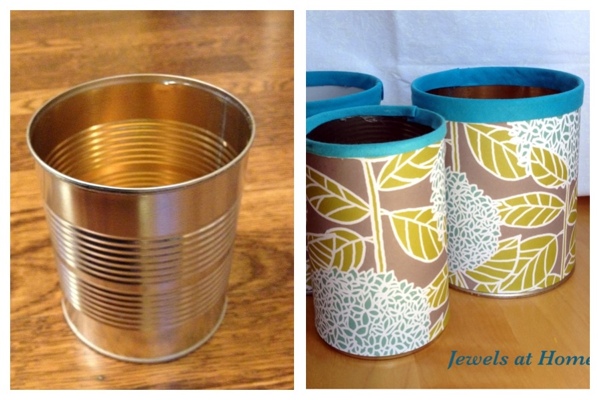
Turn used cans into beautiful pencil tins for your office.  From Jewels at Home.

Turn used cans into beautiful pencil tins for your office.

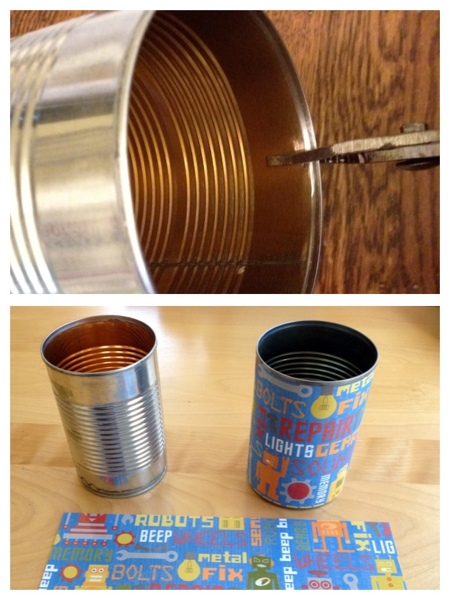
This is a very simple and quick project that needs very little explanation. I started by using pliers to flatten any sharp edges along the inside of the can.  To cut the paper neatly, I used the quilting ruler and mat I showed in the fabric growth chart tutorial.

DIY pencil tin tutorial from Jewels at Home.

Flatten the sharp edged on your can. Cut out paper and glue with a glue stick.

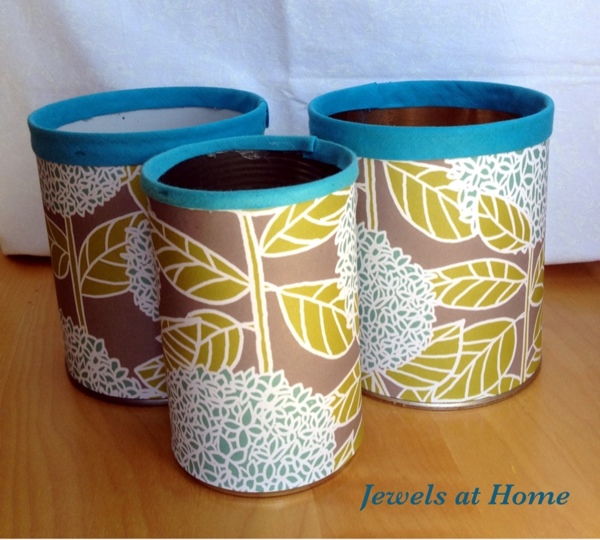
I used a glue stick to affix the paper to the tin. For my kids’ tins, I also added a layer of clear contact paper to make the tins more durable.  Finally, I use tacky glue to attach bias ribbon to the top of the tin, for a polished look.  (I tried hot glue, but it cools very fast on the metal and gets lumpy.)

Beautiful pencil tins made from old cans, decorative paper, and bias tape. Tutorial from Jewels at Home.

Beautiful pencil tins made from old cans, decorative paper, and bias tape.

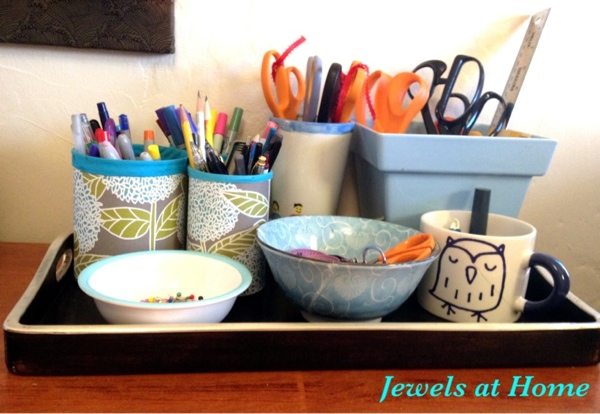
Craft room desk set: DIY pencil tins fit in with ceramics on a vintage tray.  From Jewels at Home.

Craft room desk set: DIY pencil tins fit in with ceramics on a vintage tray.

Craft room desk set: DIY pencil tins fit in with ceramics on a vintage tray.  From Jewels at Home.

DIY pencil tins.

While I was making these tins, I added some for the boys’ homework area.  These have a layer of clear contact paper over the scrapbook paper, since I know they will get more (ab)use.

Turn old cans into pencil tins with paper and bias ribbon.  From Jewels at Home.

Pencil tins for the boys’ homework area.


What else do I want to decorate with my beautiful Hydrangeas paper?  A pennant banner, some magnets, magazine files, and some storage boxes for the craft studio.  Hope to share those projects soon.  Meanwhile, go raid your recycling bin and make some new accessories for your own office!

“Jewels”


3-D Balloon Applique

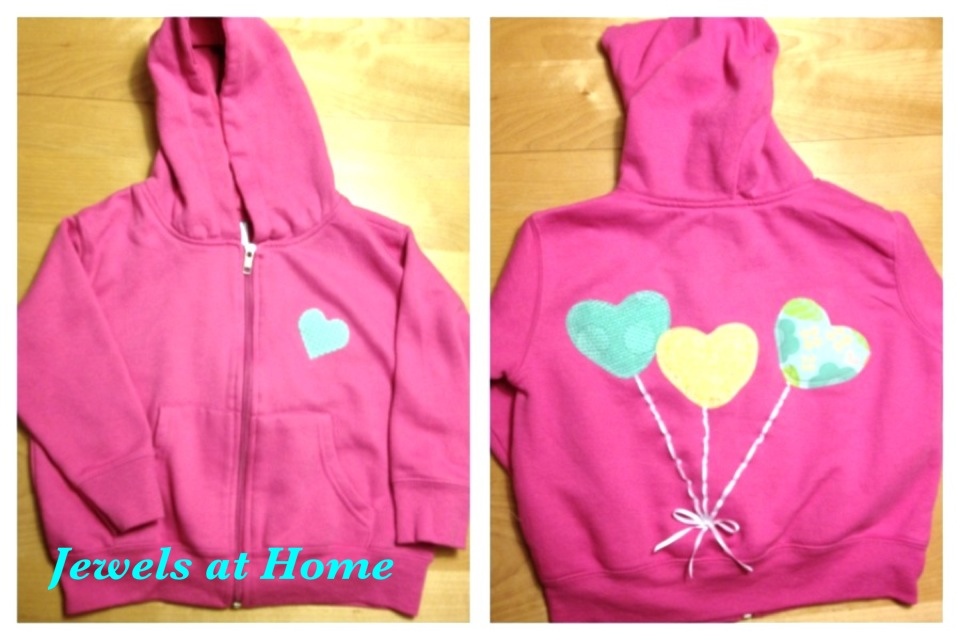
My craft projects tend to come in waves. I find a great idea and love creating variations on it. At the moment, this idea is fabric appliques for kids’ clothes. I made tie t-shirts for the boys, co-hosted a onesie decorating party for my friend Nicola, and most recently, I decorated this cute hoodie sweatshirt for our neighbor across the street, who is turning 3!

3-D balloon applique by Jewels at Home.

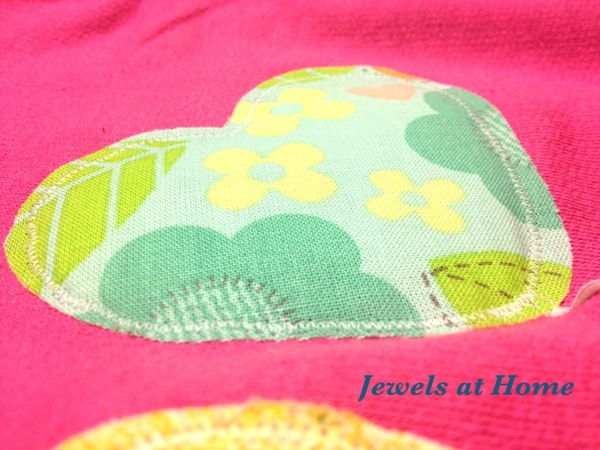
3-D balloon applique on a sweatshirt.

Here’s what you’ll need

  • sweatshirt or t-shirt
  • fabric
  • iron-on applique material, such as Heat ‘n Bond
  • batting
  • ribbon

Here’s how to make your own puffy applique:

Draw your shape in two sizes – one the size of the finished piece and one about 1/4″ smaller all around, as shown below.

3-D applique tutorial from Jewels at Home.

Following the instructions detailed for the  tie t-shirts and onesie decorating party, create a large shape with the fusible applique material on the back and cut the small shape out of batting.  The batting will flatten out when you iron it down, so use enough to make it a little thicker than you want your finished shape.

3-D applique tutorial from Jewels at Home.

Place your applique on the shirt, first the batting and then the fabric centered on top.  I also tucked some ribbon under the fabric, to make the string for the balloon.

3-D applique tutorial from Jewels at Home.

Place the batting on your shirt, and layer the fabric on top.

Iron and sew your applique in place according to the instructions for the  tie t-shirts and onesie decorating party.  I also sewed down the ribbons and tied a bow, which I also sewed in the center.   I left the loops of the bow and the bottom of the ribbons free.  My balloons didn’t turn out as puffy as I had envisioned, since they got flattened when they were ironed down, so I would use thicker batting next time.

3-D balloon applique by Jewels at Home

3-D balloon applique

3-D balloon applique by Jewels at Home

I’ve got a few more applique projects to finish up, and then I need to move on to something else!

“Jewels”

Fabric-covered Decorative Boxes

It’s a bit silly that I avidly study “styled” displays of decorative items, because I have three boys who consider it their role to re-style any arrangement I make. Nonetheless, I keep my eye out for great objects and projects to bring beauty into our home. And for now, these are all placed well above the reach of little hands.

Some staples of a beautifully accessorized room are framed art, vases, books, trays, and boxes… I love the look of a stack of beautiful boxes!

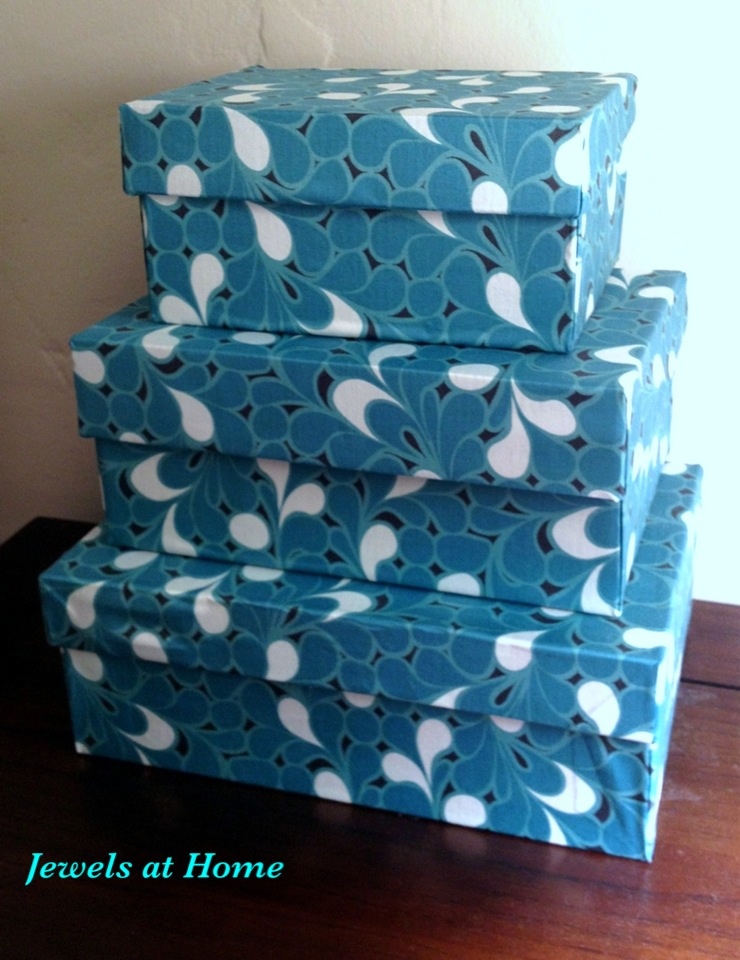
I was pondering how to make a set of boxes when inspiration came from the most unexpected source! Remember those three little boys I was talking about? At the start of summer, I ordered three pairs of sandals for them. After they arrived and were unpacked, I found myself with a set of three perfectly matched boxes in small, medium, and large!

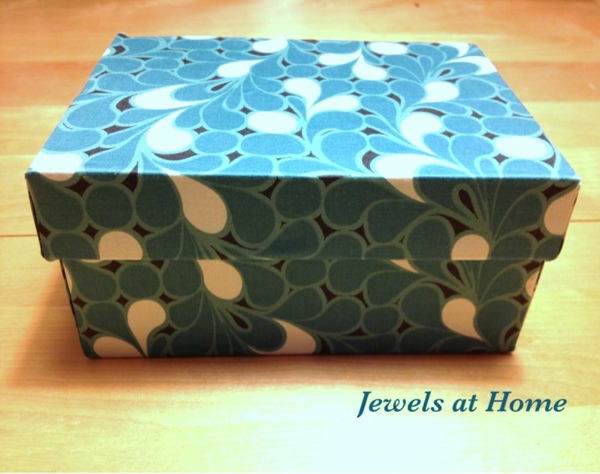
With the addition of some gorgeous fabric I found for just $2.99 a yard, those plain shoe boxes became a beautiful display!

Tutorial for DIY Fabric-covered decorative boxes from Jewels at Home.

DIY fabric-covered decorative boxes.

Here’s what you’ll need:

  • box(es)
  • fabric – I used only 2/3 yard for all three boxes. That’s a $2 project!
  • scissors
  • glue stick – I used this on the outside, for a smooth finish
  • tacky glue or white glue – I used this to glue the inside flaps, for extra security

Here’s the step-by-step:

Tutorial for DIY fabric-covered decorative boxes.  From Jewels at Home.

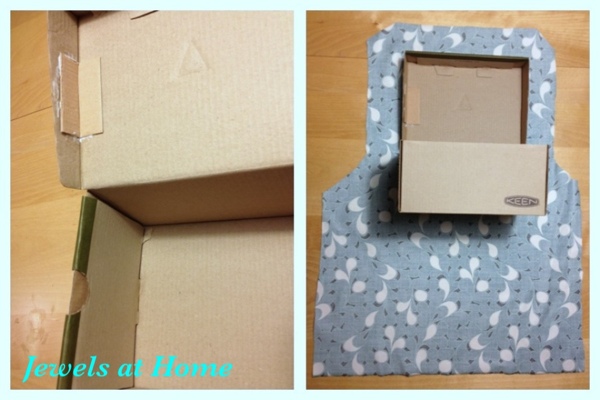
Above left: Fill in any holes in the box design with scrap cardboard.

Above right: Cut out fabric to fit wrap around box, including the sides and allowing about an inch extra to wrap to the inside.

Tutorial for DIY Fabric-covered decorative boxes.  From Jewels at Home.

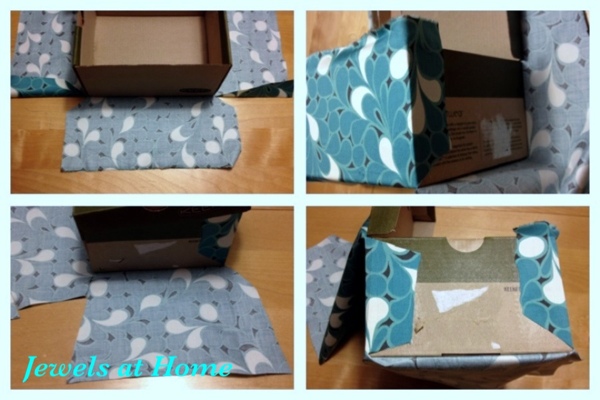
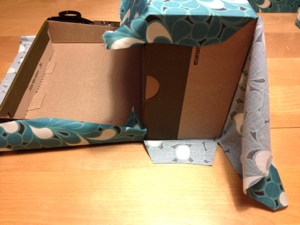
Above top: Use the glue stick to lightly attach the bottom of the box to the fabric. At each front corner, cut diagonally to the bottom corner and trim, as shown. Apply glue stick lightly and fold up the fabric onto the front of the box. Fold flaps from the front towards the side of the box and glue them down securely with the glue stick.

Tutorial for DIY fabric-covered decorative boxes from Jewels at Home.

When cutting the flaps at the back of the box, make sure to leave some fabric to wrap the edge of the lid.

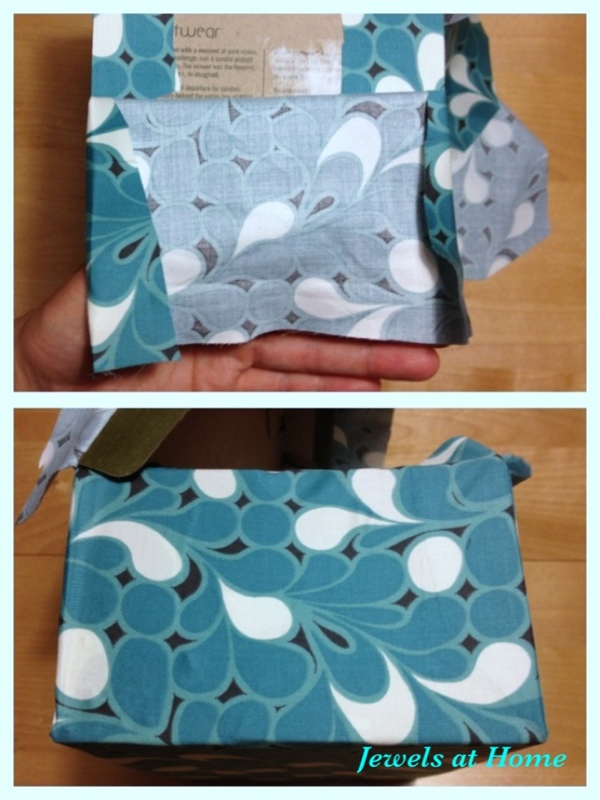
Above bottom: Apply glue stick lightly and fold fabric over the back of the box. At each back corner, cut diagonally to the bottom corner and trim, as shown. Again, fold a flap towards the side of the box and glue it down securely with the glue stick.

Tutorial for DIY fabric-covered decorative boxes. From Jewels at Home.

Above top: For the side flaps, fold in the excess, so that a finished edge lines up with the edge of the box.

Above bottom: Apply glue stick liberally, and fold up the side flaps.

Tutorial for DIY fabric-covered decorative boxes. From Jewels at Home.

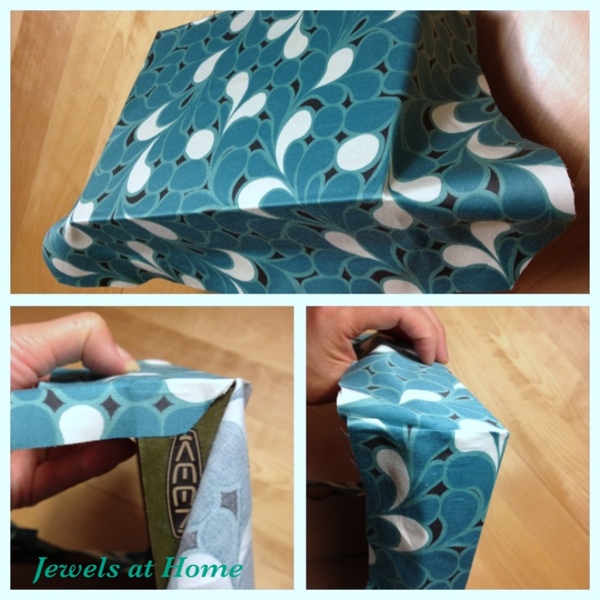
Above top: Apply glue stick lightly and attach fabric to top of box.

Above bottom: At the top corners of the lid, cut the fabric diagonally to the corners and trim. Left: Apply glue lightly to the front of the lid and then glue a flap securely towards each side. Right: fold the side flaps, so a finished edge lines up with the edge of the lid. Glue securely with glue stick.

Tutorial for DIY fabric-covered decorative boxes. From Jewels at Home.

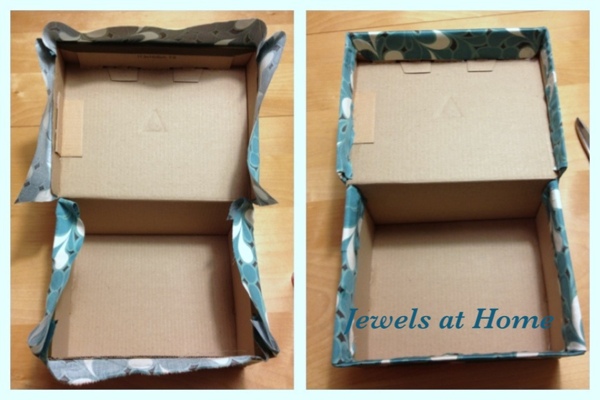
Above left: Trim excess fabric.

Above right: Use tacky glue to secure the loose fabric to the inside of the box and lid.

And you’re done!

Tutorial for DIY fabric-covered decorative boxes. From Jewels at Home.

Tutorial for DIY fabric-covered decorative boxes from Jewels at Home.

I’m so happy that these boxes are going to add a wonderful touch of color and style to our living room. So, while my newly-crafted accessories have to stay high out of reach for a few more years, I’m tickled to know that those rambunctious boys who usually mow down all my decorating projects can be credited with inspiring this one!

What ordinary objects will you turn into the extraordinary?

Love,
“Jewels”

Decorate a Quilt Block – Party Activity

It has been a few months since I organized a bug-themed birthday party for our six year -old. At the party, he and his friends drew pictured on blank quilt blocks, and I’m finally getting around to finishing the quilt.

This was a very simple quilt but one with a lot of meaning. My friend Ari’s mother is a talented quilter, and Ari and I had helped her make quilts for the school auction, first with our older kids’ class and more recently with our younger ones. Through some type of temporary school spirit insanity, hubby ended up purchasing the first quilt, but our wallets were not up buying another quilt this year, and I wanted to find a way to make it up to our second boy. As I am sure all of you with multiple children know, our love for each of them is unique, but it does seem that the second – and in this case also middle – child tends to feel a need to fight for your attention and love. This instinct can make our dear boy act out some times, and I’m always looking for ways to remind him that he is special. This quilt was a part of that effort as well.

Before the party, I cut 7.5″x7.5″ squares of white pre-washed cotton and taped them on to cardboard for stability. I cut more than enough for the guests, and it is a good thing, because many of the kids wanted to draw more than one picture, including the birthday boy himself, who drew three! I also set out fabric markers. I like these Marvy Uchida Fabric Markers that come in many beautiful colors.
Decorate-a-quilt-block activity at a birthday or baby shower.  From Jewels at Home.

Decorate-a-quilt-block is a great activity for a birthday or baby shower.

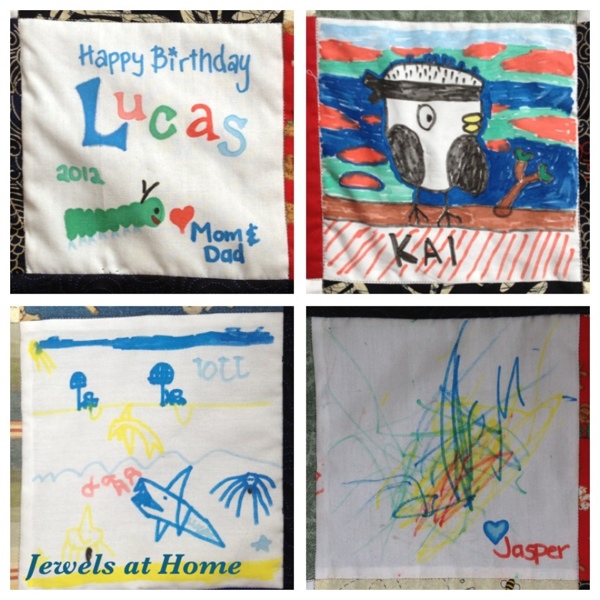
Here is how some of the quilt blocks turned out. Each one is different and expresses the artist’s personality, but they work together.

Incorporate drawings into a memory quilt.  From Jewels at Home.

Incorporate drawings into a memory quilt.

And here is the finished quilt! As I mentioned, this is a simple quilt. I found fabrics that had animals and other prints in a range of primary colors and mixed them randomly with the drawings (and I should add that mixing “randomly” actually took ages, because I wanted to balance out the colors through the quilt).

Quilt incorporating blocks drawn at a birthday party.  From Jewels at Home.

Quilt incorporating blocks drawn at a birthday party.

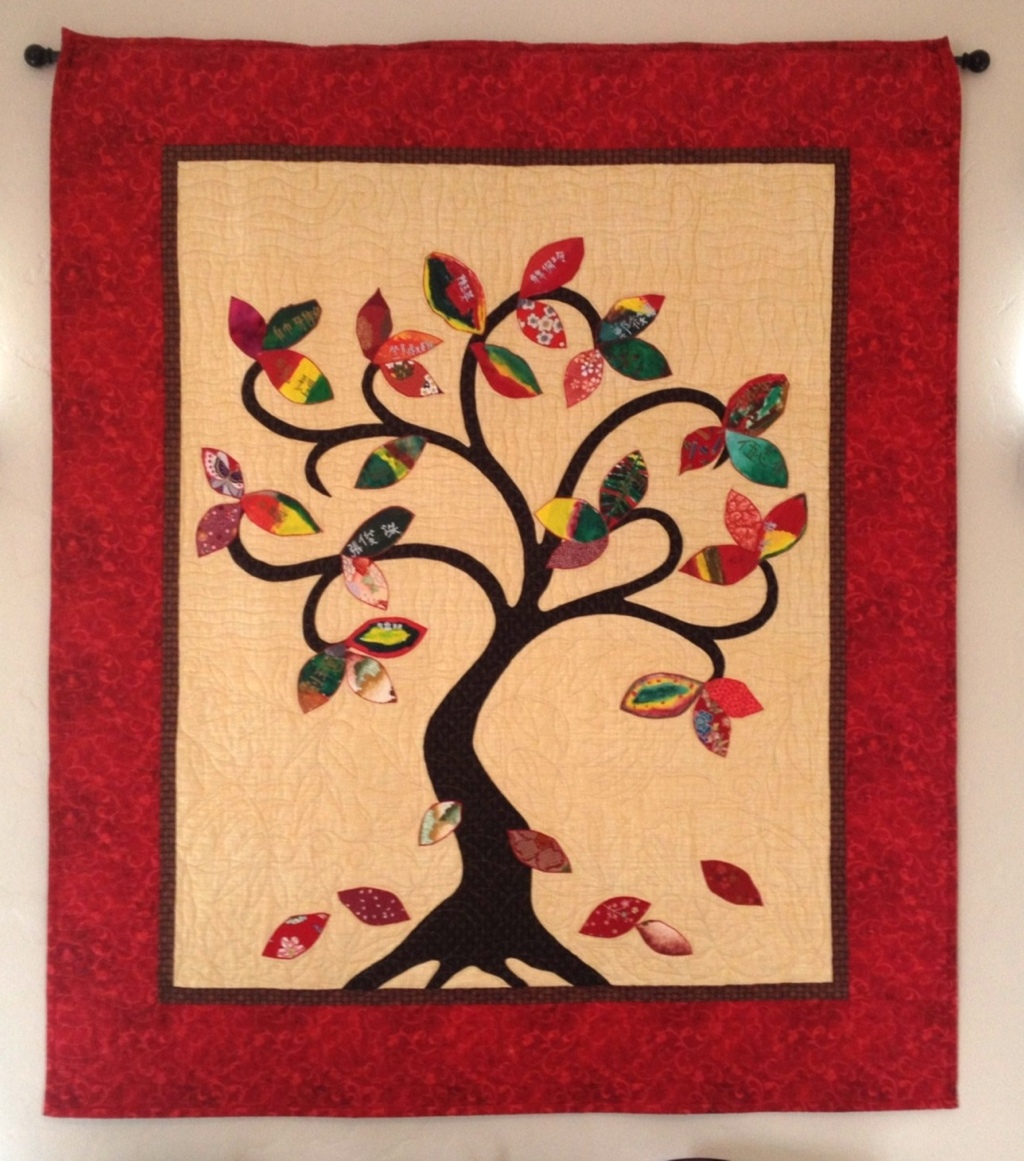
By the way, here is how the amazing inspiration for this project looked. Ari’s mom designed the pattern, and each child in the class painted a leaf. It’s hanging in our older boys’ room, and I love looking at it every day.

"Family Tree" quilt for a classroom art project.

“Family Tree” quilt for a classroom art project.

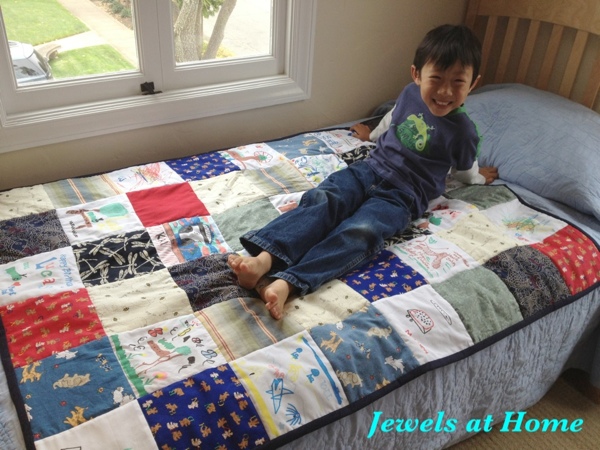
Though far, far more humble from an artistic perspective, I think this smile says that the new quilt’s recipient appreciates his special keepsake.

Quilt made with blocks drawn at a birthday party.  From Jewels at Home.

Quilt made with blocks drawn at a birthday party.

To finish the quilt, I sewed a label on the back with a special message for Lucas.  You could also have party guests all sign a fabric quilt label.  That’s what we did with the class quilt for Lucas’ class – each child signed the back.  And I know first-hand how special it is to have the story of a quilt sewn on the back.  Below is a quilt that is hanging in my craft studio.  My mom made it for my birthday, and while she made many beautiful quilts, this one has particular meaning, because she made it when she was sick from chemotherapy.

A label on the back of a quilt helps tell its story.  From Jewels at Home.

A label on the back of a quilt helps tell its story.

A special quilt with its story on the back.  From Jewels at Home.

A special quilt with its story on the back. From Jewels at Home.

So, finishing this quilt definitely overdue, but hopefully, it was worth the wait, and I hope our little guy can feel how much he is loved, when he curls up under it.

“Jewels”


Onesie Decorating Party

When I first saw the idea of doing appliqué onesies at a baby shower at the Cutting Table, I immediately thought of doing this project at Nicola’s baby shower. I did have some trepidation about having to stitch around the appliqués, but thankfully my co-host Maura convinced me that it would be worthwhile, and it certainly was.

Here’s what you’ll need to do this at your party:

  • blank onesies. I was unable to find these in any color besides white in local stores, but I ended up getting a good selection between Rock Bottom T-Shirts and these Disney solid bodysuits. These MoonTree Kids Bold Colors Bodysuits are very cute as well! I got a range of sizes from newborn to 18 months, because we all know how fast babies grow!
  • fabric – I pulled a bunch from my stash, and Maura brought an adorable charm pack
  • fusible webbing – I used Heat ‘n Bond Lite Iron-on Adhesive
  • iron and ironing board
  • pencils
  • scissors
  • optional: stencils or objects to trace (cookie cutters are good for this), examples of appliqued onesies
Supplies for a DIY Onesie Party from Jewels at Home.

Supplies for a DIY Onesie Party.

I wrote up a set of instructions with a storybook theme that you can download here: DIY Onesie Instructions from Jewels at Home. It also helped to show the first people step by step, and then they helped the next group. It all went quite smoothly, and there were just two that I needed to fix up afterward, because the Heat ‘n Bond didn’t stick. I’ll show you the “rescue” tips later in the post, but first, here are the step-by-step instructions for decorating the onesies.

DIY Onesie Tutorial

  • Choose a design and fabrics.
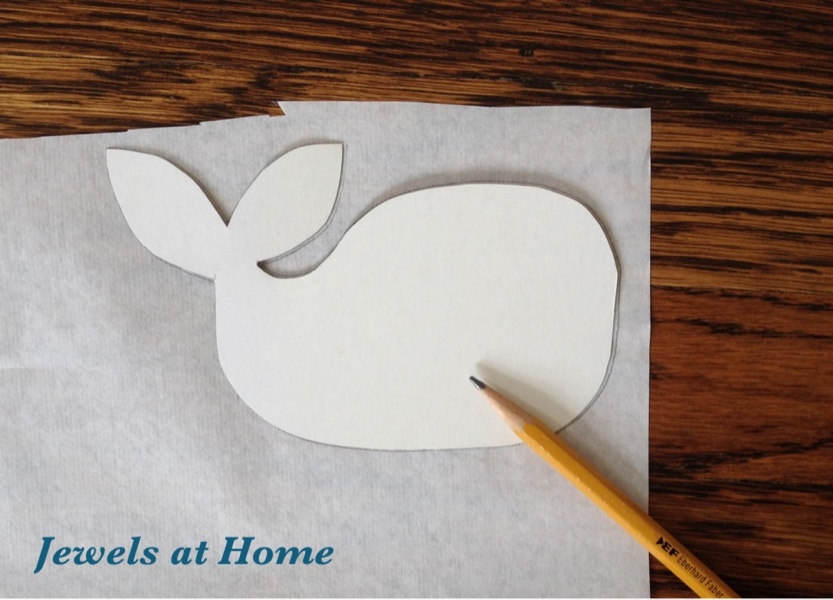
  • Sketch your design onto the paper side of the iron-on paper. Note: your drawing will be reversed when the design is finished, which is important for letters.
Sketch your design onto the paper side of the Heat 'n Bond.

Sketch your design onto the paper side of the Heat ‘n Bond.

  • Cut out the paper with your design with a small margin around it
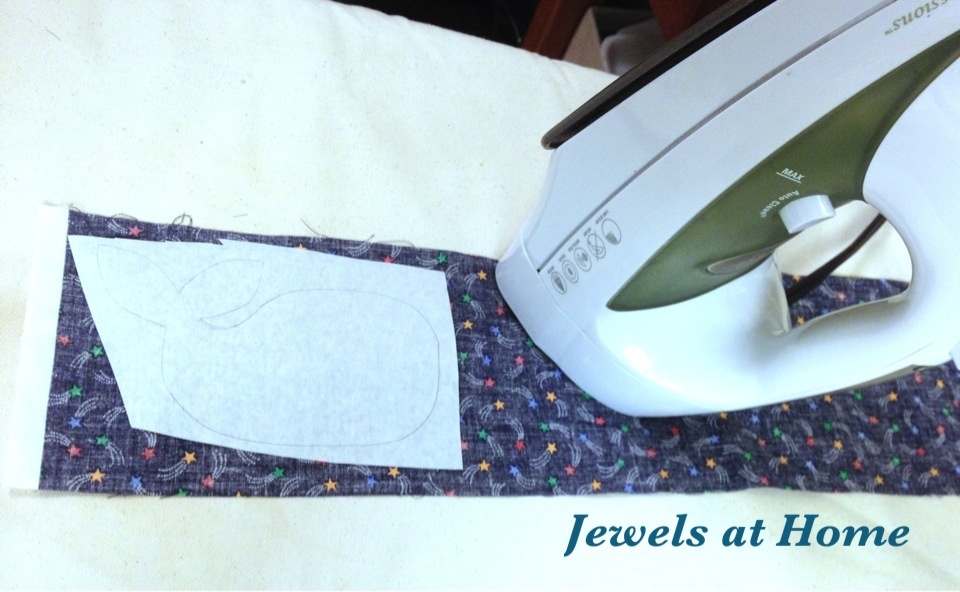
  • Place the sticky side of the Heat’n Bond Lite facing the back side of the fabric and iron for just 2 seconds.
Cut out your design and iron it to the backside of the fabric.

Cut out your design and iron it to the backside of the fabric.

  • Cut out the design exactly along the lines you sketched
  • Peel off the paper backing
  • Place your design on the onesie and iron for 8-10 seconds
  • Optional: Add words or details with the fabric markers. We signed the “bums” with our names!
Sign your DIY onesie.

Sign your DIY onesie.

DIY Onesie Party from Jewels at Home.

Onesie decorating party. I love how each one is unique!

DIY Onesie Party from Jewels at Home.

DIY Onesie Party from Jewels at Home.

Finishing the Onesies

After the party, Maura and I split up the onesies to take home and sew the edges. For the simple outlines, I used a small zig-zag stitch, which I think is the most secure. For the ones with fine details, I used a straight stitch, so I could follow the shape more neatly.

DIY Onesie Party from Jewels at Home.

Finish the onesies by sewing around the appliques with a zig-zag or straight stitch.  I used a zig-zag for the simple shapes, as I think this will be the most secure.

DIY Onesie party from Jewels at Home

Finish the onesies by stitching around the edge of the fabric. I used a straight stitch for more detailed designs like this one.

If you end up with some onesies with appliques that didn’t stick, I thought of two ways to rescue them.

  • Pictured below, place the fabric on the sticky side of the Heat’n Bond Lite. Use some glossy paper (this is from some contact paper) face down on the fabric, and iron. Cut out carefully.
  • You could also place the fabric on they sticky side of the Heat ‘n Bond, trace around the design with pencil, and cut out the paper. Then iron the fabric onto the cut-out paper.
Adding Heat 'n Bond to the fabric, after it is already cut out.

Adding Heat ‘n Bond to the fabric, after it is already cut out.

This was a lovely project – it was wonderful to see so many people try it, even those who don’t usually do craft projects, and it was fun to see how each onesie reflected a little bit of the artist’s personality.

Can’t wait to see these on the new baby!

“Jewels”

Fabric-covered Hairband Tutorial

Here’s a quick and easy project… And that’s a good thing for me, because after I cut my hair short recently, I realized that I couldn’t brush my teeth without my cute new style falling into my face. I literally ran next door to my craft studio and whipped up this hairband, so I could get ready for bed.

You’ll need

  • wide elastic – I used a little under 2′ of 3/4″ wide elastic.
  • fabric – just a small strip about 22″x 2.5″
  • needle and thread
  • optional but handy! Chopstick and a large safety pin

1) Cut your elastic so that it fits comfortably around your head while gently stretched with an inch overlapping

2) Cut your fabric about the same length as your unstretched elastic and 2.5″ wide

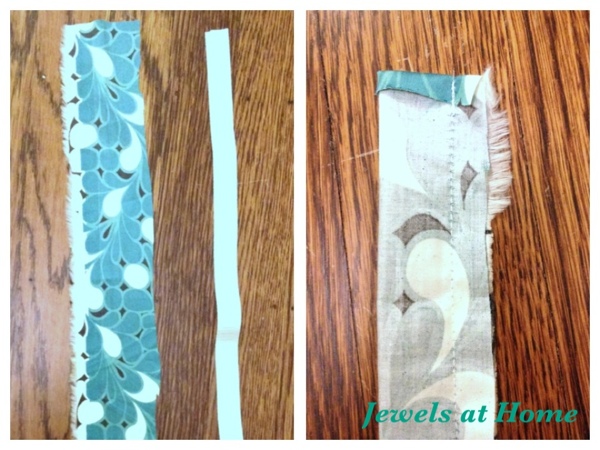
3) Fold the fabric lengthwise with right sides together.  Fold down a hem on either end and stitch with a 1/2″ seam allowance.

Fabric hairband tutorial.

Fabric hairband tutorial.

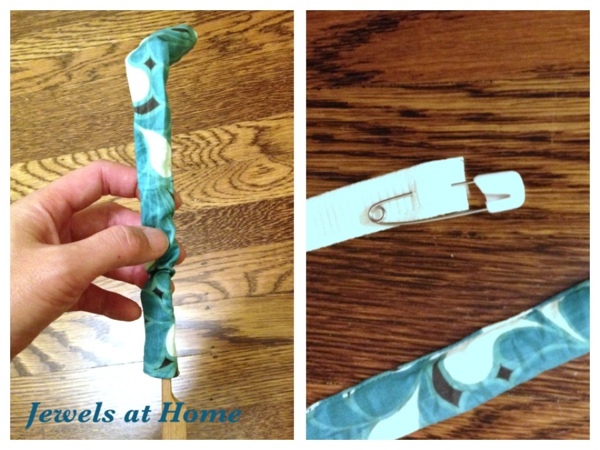
4) Turn the fabric cover right side out.  My mom taught me the trick of using a chopstick to help turn narrow things right side out.  What do people without chopsticks do??

5) Thread the elastic through the fabric cover.  My mom taught me another trick: use a large safety pin (I used a diaper pin) to help pull elastic or cording through a narrow sleeve.  It gives you something to grasp on to!

6) sew the ends of the elastic securely together with a one inch overlap.

7) sew the ends of the fabric cover closed by hand.

Sewing tricks: Use a chopstick to turn a narrow sleeve right-side out.  Use a safety pin to thread elastic or cord through a narrow sleeve.

Sewing tricks: Use a chopstick to turn a narrow sleeve right-side out. Use a safety pin to thread elastic or cord through a narrow sleeve.

Fabric hairband tutorial from Jewels at Home.

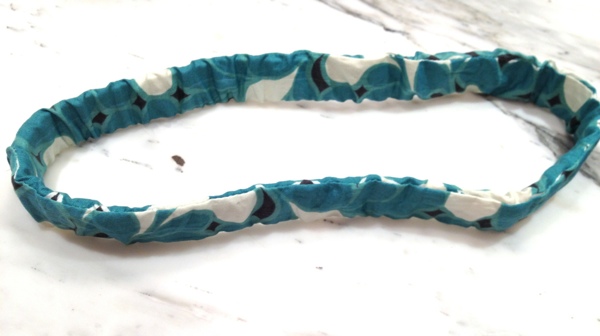
Finished fabric hairband.

Fabric hairband tutorial from Jewels at Home.

Finished fabric hairband.

I’ve got some bigger projects in upcoming posts, like the rest of the baby shower and some new cushions.  Look forward to sharing those soon!

“Jewels”